The Bishop of Shrewsbury has expressed his sadness after an assisted suicide was voted narrowly through the House of Commons.
The Rt Rev. Mark Davies described the by 314 votes to 291 – a majority of just 23 – at the Third Reading of the Terminally Ill Adults (End of Life) Bill as “seismic” and said he hoped that the battle to defeat the legislation would continue.
Bishop Davies said: “It is a sad moment for us all and especially for those most vulnerable that the House of Commons has opened the door to euthanasia in the guise of ‘assisted dying’.
“We may be incredulous that such a seismic change to society was effected by what is widely acknowledged to be a deeply-flawed Bill passed after a few hours of debate, albeit with a small majority.
“We can hope that in the House of Lords there may be a reassessment of this legislation with all its dangers.
“We can also take heart in the public witness awakened in opposition to euthanasia and for the value of every human life; concern for safeguarding the sick and the aged in their vulnerability and truly assisting the dying in the provision of palliative care. This must surely remain our priority.”
Cardinal Vincent Nichols, the Archbishop of Westminster and the president of the Bishops’ Conference of England and Wales, said Catholics must also do whatever they could to persuade peers to reject the as it begins its way through the House of Lords.
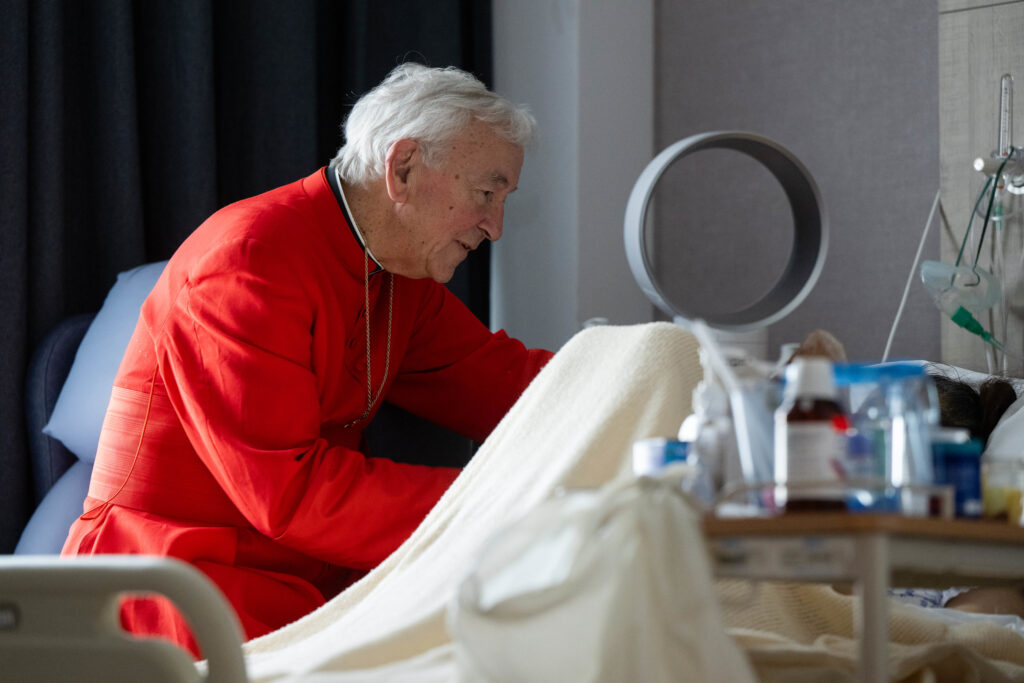
The Cardinal (pictured with a patient at St Joseph’s Hospice, London) described the vote by MPs to approve the Bill as “a watershed moment in the history of our country”.
“It fundamentally changes society’s long held values and relationships on matters of life and death,” said Cardinal Nichols.
“The task is now clear: every effort must be made to limit the damage that will be done by this decision.
“This duty lies both on the House of Lords and on His Majesty’s Government. The list of challenges is long.
“It has been well rehearsed in recent weeks by responsible bodies and distinguished individuals, including the Public Commission on Palliative and End-of-Life Care whose recommendations have yet to be discussed.
“The appeal to personal autonomy, so much at the centre of the Parliamentary debate, cuts both ways: the provision of a choice to die cannot exclude the provision of properly resourced care for those who choose to live until a natural death.”
He continued: “As Catholics we will continue to play our part in the building of the common good.
“The decision of Parliament does not change our firm belief in the sanctity of life, never simply a burden, but always a gift of God, given and received.
“Our duties are clear: to live by the teaching given to us by God; generously to accompany with care and compassion those facing disability, isolation and suffering; to continue to put forward, with respect and clarity, the objective norms that inform our firm beliefs on how to live, and to die, well.”
The private member’s Bill of Kim Leadbeater, the Labour MP for Spen Valley, will allow adults who are deemed to have fewer than six months to live the right to be assisted by a medic in committing suicide.
Such applications must be signed off by two doctors and also approved by a panel consisting of a social worker, a lawyer and a psychiatrist.
The majority of the votes in favour of the Bill was much shorter than at Second Reading in November because of enduring concerns that proposed safeguards were ineffective.
At Second Reading in November, the vote share was 330 to 275, a majority of 55.
The Catholic Church is fundamentally opposed to euthanasia and assisted suicide because they directly contradict the Fifth Commandment: “You not kill.”
Earlier in the week, Cardinal Nichols expressed fears that Catholic institutions will not be able to stay open if the Government insists they must facilitate such killings.
“Institutions whose mission has always been to provide compassionate care in sickness or old age, and to provide such care until the end of life, may have no choice, in the face of these demands, but to withdraw from the provision of such care,” he said in a joint statement with Archbishop John Sherrington of Liverpool, the lead bishop for life issues.
“The widespread support which hospices attract from local communities will also be undermined by these demands which, in many cases, will require these institutions to act contrary to their traditional and principled foundations.”
Church lawyers have advised the bishops that the Government will issue regulations to enforce assisted suicide provision in care homes and hospices following the principles of equality of access to a “service”, which is invariably given priority over institutional freedom.
The provision of assisted suicide could be tied to government funding of hospices, to the local authority funding of care home residents or to local health authority contracts.
(Photo © Mazur/cbcew.org.uk)