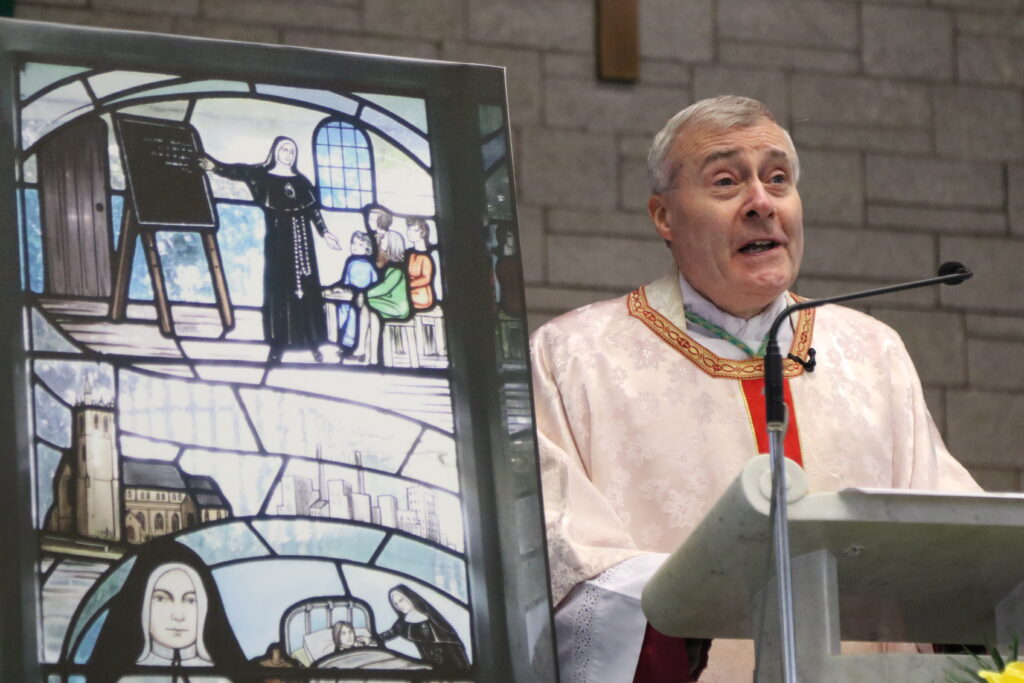
The journey we have made to Sutton today forms part of a revival in pilgrimage among our contemporaries who set out in search of sometimes undefined goals and yet are drawn by the attraction of holiness to those places where the call to holiness continues to re-echo in our time. In this way we accept the invitation of Jesus Himself who urges us to dig deeper, “like a man building a house who dug deep and laid the foundation on rock”[i].
The earthly pilgrimage of the Venerable Elizabeth Prout was such a journey, made first into the full communion of the Catholic Church at that same mid-century moment as Saint John Henry Newman. If Newman was led by his study of the Fathers of the Church and her history; Elizabeth was led by the preaching of Blessed Dominic and the first Passionist missionaries to live and announce the ‘memory’ of His Passion. In digging deeper, she found her unexpected vocation to go into the alien landscape of the first industrial slums, where people found themselves spiritually and morally disoriented amid inhuman conditions. Elizabeth Prout did not join Marx and Engels in their social analysis in the nearby Chetham’s Library demanding revolutionary violence which would eventually condemn millions to still greater misery and despair. Elizabeth was able to dig deeper into the resources of faith, prayer and lived virtue, to offer hope to the people among whom she was ready to live and die as a sister.
The story of her religious life is well known to you who have lived the same vocation in the community she founded as Mother Mary Joseph. Yet, in the landscape of contemporary British society we are all called by her witness to draw on those same resources of faith and grace wherever human life and dignity are today threatened.
We cannot fail to think of the lives of the most vulnerable being threatened by medical killing in a seismic change to the way British society views the sick and elderly. In the alien landscape into which euthanasia threatens to lead us, Elizabeth Prout stands in witness to the values we may be in danger of losing: reverence for human life and the care we owe to each other even to the point of sacrifice.
We might draw a comparison with the droughts of this past summer, when it was reassuring to know that reserves of fresh water remain in the rock formations deep beneath our feet. So even if all seems lost on the scorched surface, plants with deep roots were able to draw on this water to sustain their life. The same we might say is true of societies of Christian foundation like our own, when everything on the surface appears threatened, we can still draw on the deep roots and resources of our Christian inheritance to renew our life. In the notorious slums which bore beguiling names such as “Angel Meadow”, Elizabeth Prout similarly set out in the Manchester of 1849 to support the dignity of women, the education of the young and the care of those most abandoned.
In giving thanks today for her life and witness at the beginning of the industrial age, we might ask where we should go as pilgrims to find her memory in 21st Century. In Shrewsbury, I often pass the high walls of the brewery where she was born and the once Franciscan Church of Saint Julian where she was Baptised. Today we have come to Sutton Monastery where her body was finally laid to its rest. Yet, it is perhaps in those darkest places where hope and human dignity are now threatened, that her witness will call us to share her pilgrimage. Today, we ask her prayers and pray the holiness of her life will be recognised and raised up in the sight of the Church, that in all we seek to build, we may dig as deep and find the same foundation, Christ Himself.
[i] Lk. 6: 48
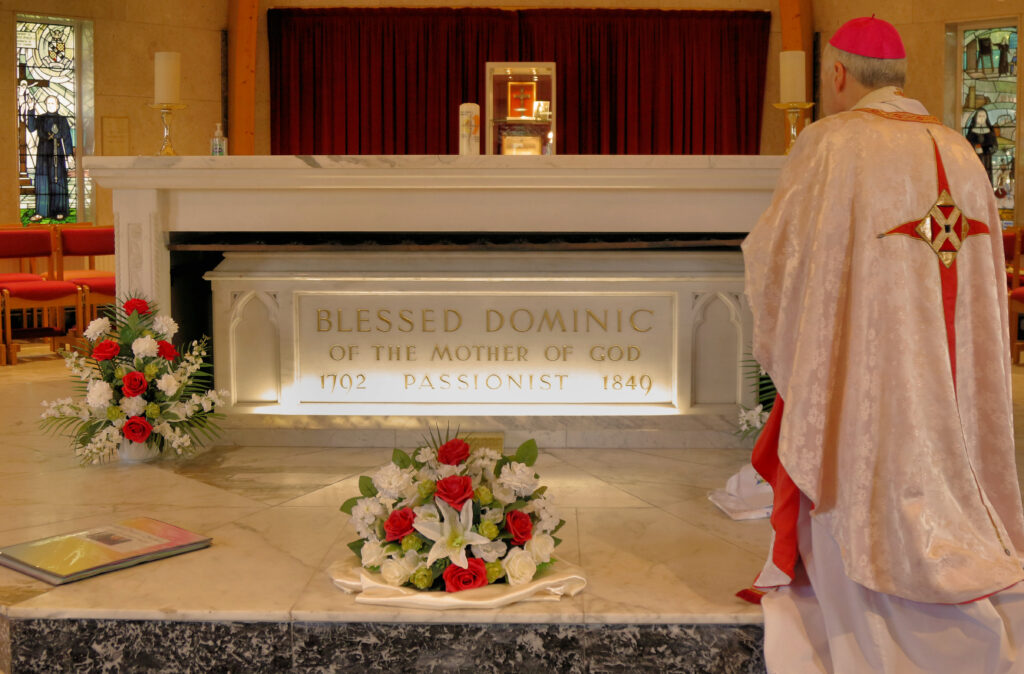
(Pictures of Bishop Davies preaching at the Mass for Venerable Elizabeth Prout in the Church of St Anne and Blessed Dominic Barberi, and praying at the tomb of Blessed Dominic, taken by Simon Caldwell, Sept. 13, 2025)