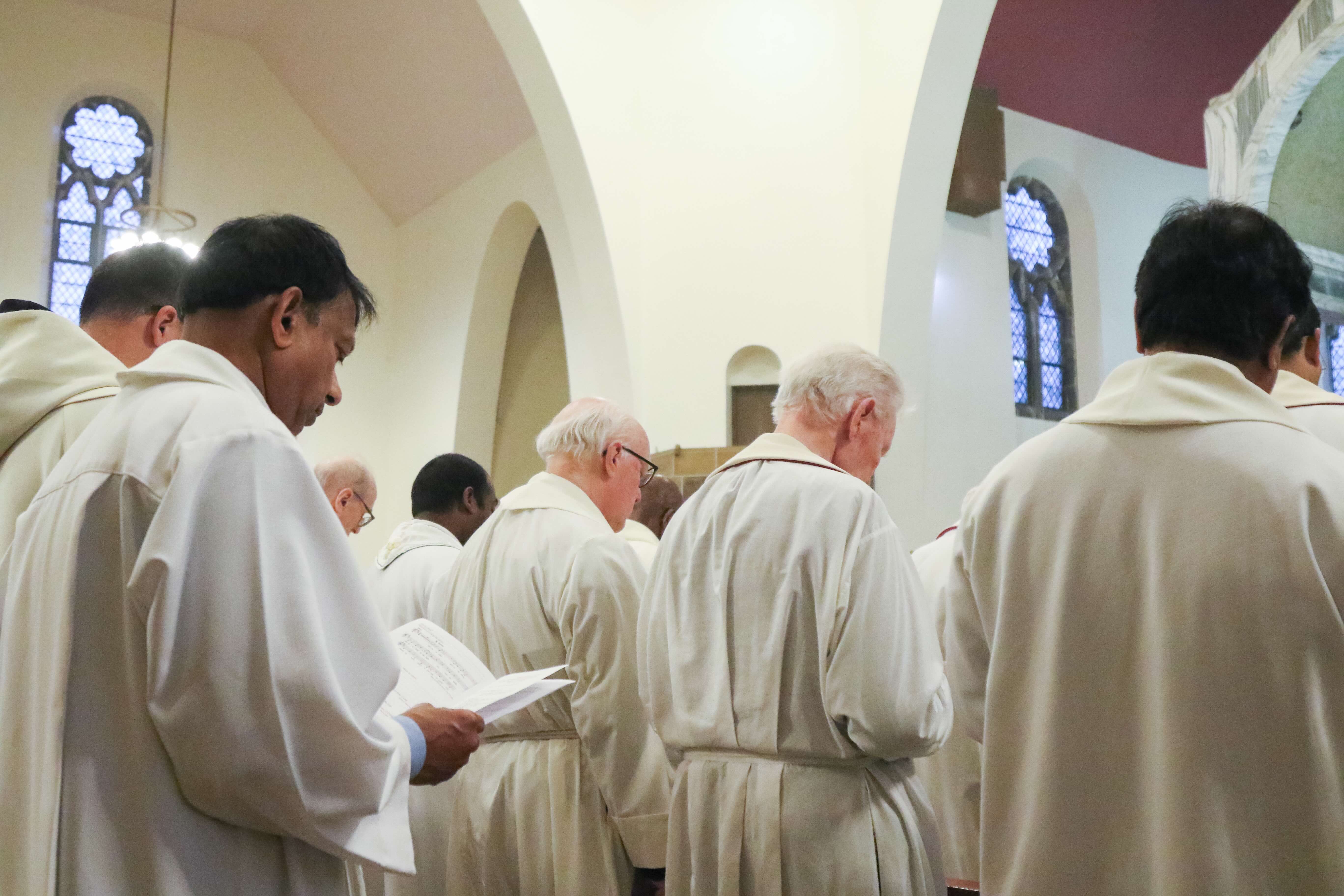
What a faculty is
A faculty is the formal written permission of the Bishop for works that affect the liturgical interior of a Catholic church. It is not a planning consent and not a property approval, although both may be needed alongside it. A faculty is the act by which the diocesan Bishop, advised by the Diocesan Art and Architecture Committee, judges that proposed changes to the sanctuary, the altar, the font, the tabernacle, the sacred art or the fixed liturgical furnishings serve the worship of the Church and respect the patrimony of the building.
Reordering is not redecoration. It touches the most sacred parts of the church. The Diocese of Shrewsbury treats faculty applications with care.
What needs a faculty
- Repositioning, replacing or rebuilding the altar, the ambo or the tabernacle.
- Moving, replacing or removing the font.
- Changes to fixed pews or sanctuary furniture.
- Removal, replacement or significant cleaning of stained glass, statues or stations of the cross.
- New sacred art commissioned for permanent installation.
- Reorientation of the sanctuary or any change affecting the spatial logic of the liturgy.
- Lighting schemes that change the visual hierarchy of the sanctuary.
- Permanent removal of any object that has been used liturgically.
Routine cleaning, like-for-like repair, and minor repainting normally do not require a faculty, but ring the Curial Office before assuming.
A recent example: the new altar at Shrewsbury Cathedral
The dedication of the new altar at Shrewsbury Cathedral is the standard the diocese holds up. The altar was designed and made in continuity with the Pugin and Talbot patrimony of the Cathedral. Bishop Davies set the relics into the altar at the dedication.
From earliest centuries, the tombs of the saints who had given their lives for Christ formed the altar. This ancient tradition continues by placing of the relics of the saints into the altar over which the Eucharistic Sacrifice will be offered. Into the Cathedral's altar will be placed the relics of Saint Polycarp, bishop and martyr, at the dawn of 2nd Century; relics of the greatest of Parish Priests, Saint John Mary Vianney who died in 1859 and whose ministry for a new evangelisation in Europe marked the first years of our Cathedral's life; and of the relics of lay Christians, Saint Charles Lwanga and the Martyrs of Uganda who gave their lives in June 1886 during the lifetime of our Cathedral.
Bishop Mark Davies, dedication of the new altar at Shrewsbury Cathedral.
That depth of theological intent is what the Bishop and the Art and Architecture Committee look for. A faculty application that reads as a redecoration brief will not progress.
The seven steps
- Begin with a parish conversation. The parish priest, with the Parish Pastoral Council and Finance Committee, drafts an outline of the desired works and the theological and pastoral reasons for them.
- Engage a qualified architect or designer with experience of Catholic church reordering and listed buildings if applicable. The Property Office can suggest names.
- Submit a pre-application enquiry to the Curial Office at info@dioceseofshrewsbury.org. Provide the outline, photographs, indicative drawings and a short theological and pastoral rationale.
- Receive guidance from the Diocesan Art and Architecture Committee. The Committee may suggest revisions, request alternatives, or recommend specific consultations (with Historic England, the Twentieth Century Society, the Catholic Bishops' Conference Liturgy Office) before formal submission.
- Prepare the formal faculty petition. The petition includes detailed drawings, specifications, materials, the theological rationale, the parish funding plan, the architect's report, and any statutory consents (Listed Building Consent, planning, Historic England comments).
- Submit to the Bishop via the Curial Office. The Committee makes its recommendation; the Bishop makes the decision. A faculty is issued in writing if granted, normally with conditions.
- Carry out the works under the conditions of the faculty. Photograph the work in progress and on completion. Submit the completion report to the Property Office. Pay any outstanding fees. Update the parish records.
Listed buildings and ecclesiastical exemption
The Catholic Church in England and Wales operates a system of ecclesiastical exemption for certain works to listed buildings, agreed with the state. The Diocese of Shrewsbury follows this framework. The Art and Architecture Committee is the body that exercises the exemption on the Bishop's behalf for many works. For others, full Listed Building Consent from the local authority is required as well as the diocesan faculty. The Curial Office advises on the route.
Timescales
Allow six to twelve months from first conversation to faculty in hand for a meaningful reordering project. Small projects may be quicker. Listed buildings, contentious removals and new commissions of art take longer. Plan with the Easter and Christmas seasons in mind: avoid asking the Committee to consider major works in Holy Week or in the run-up to Christmas.
Funding
The parish funds the works, normally from parish reserves, fundraising and grants. Heritage routes include the National Churches Trust, the Allchurches Trust, and where the building is listed, Historic England. The Art and Architecture Committee can suggest sources but does not itself fund parish projects.
Key contacts
- Curial Office: info@dioceseofshrewsbury.org, 0151 652 9855.
- Address: 2 Park Road South, Prenton, Wirral CH43 4UX.
- Charity: Shrewsbury Roman Catholic Diocesan Trust, registered charity number 234025.
A reordering done well lifts the parish for a generation. A reordering done badly is felt at every Mass for the same length of time. The faculty process is how the diocese keeps the bar high.