The strangest piece of jewellery in the world
For two thousand years, the most loved symbol in human history has been a Roman execution device. There are crosses on flags, on graves, on rooftops, on hospitals, on the chains around the necks of grandmothers. Bishop Mark Davies noted in his Christmas message that the flags lining Britain's streets carry the cross of Christ, whether anyone notices or not. Something happened on Calvary that turned an instrument of death into the most cherished image humanity has produced.
The Catholic Church says what happened was the redemption of the world.
What was wrong in the first place
You cannot understand the Cross without what humanity had done. The Catechism is plain.
By his sin Adam, as the first man, lost the original holiness and justice he had received from God, not only for himself but for all human beings.
Catechism of the Catholic Church §416
Original sin is not the claim that you are personally to blame for what Adam did. It is the claim that the human race comes into the world wounded, alienated from God, prone to choosing self over love. We make promises we cannot keep. We betray the people we love. We know what is good and we do the other thing. I do not do the good I want, but the evil I do not want is what I keep on doing, wrote St Paul (Romans 7:19).
No human effort closes that gap. No moral self-improvement programme covers a debt of that size. Only God could.
What the Cross actually did
On Good Friday, the eternal Son of God, who had become a real man in Jesus of Nazareth, allowed Himself to be nailed to a Roman cross outside Jerusalem. He was not overpowered. He had said the night before, No one takes my life from me, but I lay it down of my own accord (John 10:18). What He did there, Catholics believe, was the one perfect act of love that humanity owed to God and could never give. He gave it as one of us, on behalf of all of us.
St Paul puts it as plainly as anyone has. God shows his love for us in that while we were yet sinners, Christ died for us (Romans 5:8).
Three things happened at once.
- Sin was atoned for. The infinite weight of human sin was met by the infinite love of the Son of God.
- Death was conquered. Jesus died, but in dying He carried a humanity united to God into death itself, and three days later He came out the other side. Death no longer has the last word for those who belong to Him.
- The way back was opened. The veil of the Temple, which had separated the holy place from the people, was torn from top to bottom (Matthew 27:51). The Father is now reachable, through the Son, in the Spirit, by anyone who comes.
The Cross at the centre of Shrewsbury
When Pope Leo XIV was elected in 2025, the world watched the balcony of St Peter's. Bishop Davies noticed what came out first.
It seemed significant that before we caught sight of our new Pope, we saw first the Cross of Christ carried onto the balcony of Saint Peter's. For the Pope always stands before the world as a witness to Christ and to the victory of His Cross.
Bishop Mark Davies, Pastoral Letter on Welcoming Pope Leo XIV with Great Joy
The Cross goes first. The Pope follows. That is the shape of the Catholic faith.
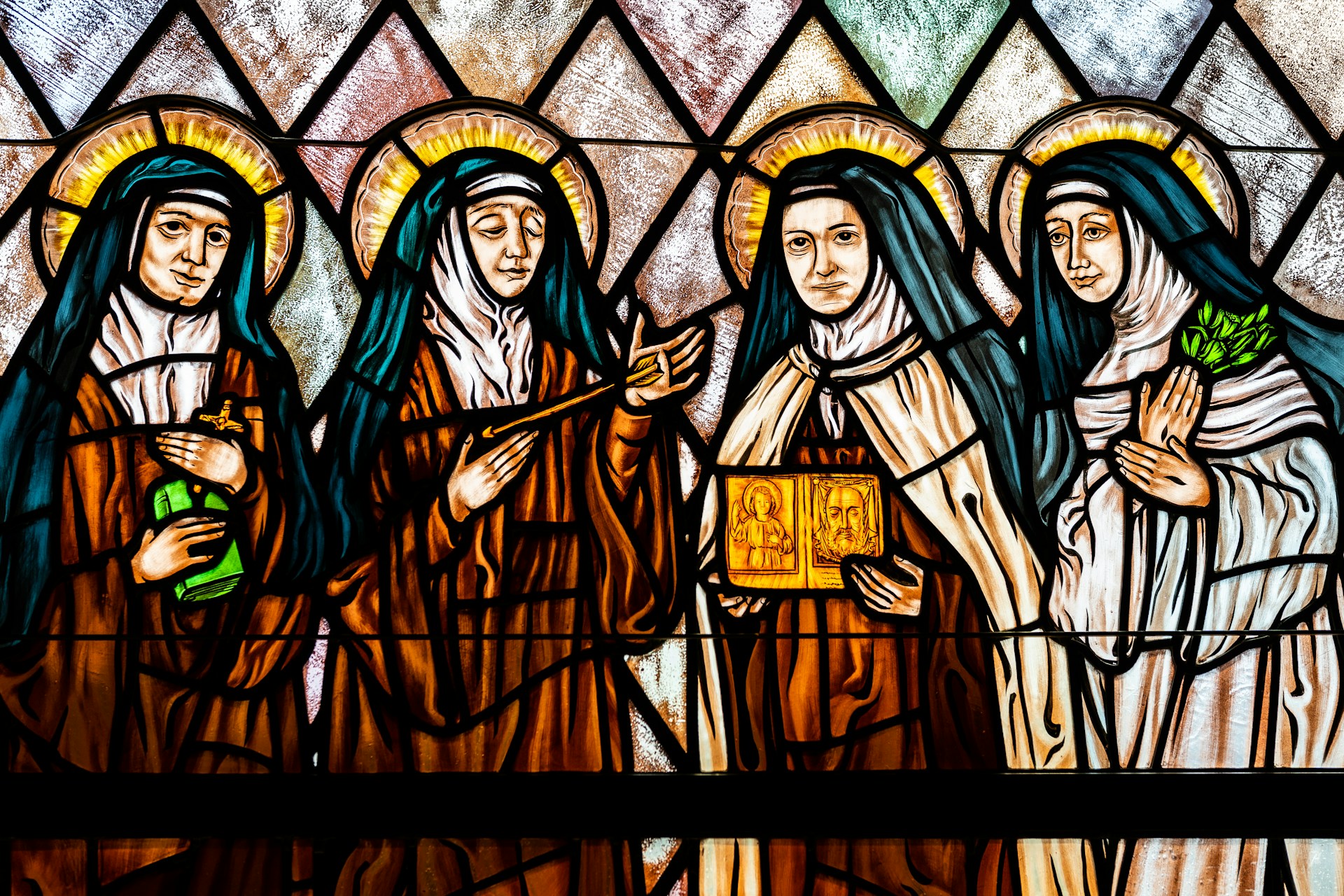
Walk into Shrewsbury Cathedral and you will see it. A crucifix above the high altar. The Stations of the Cross around the walls. Margaret Rope's stained glass, made by the Shrewsbury-born artist who became a Carmelite nun. The new altar, dedicated by Bishop Davies, sealed with the relics of St Polycarp, the Uganda Martyrs, and St John Vianney. Every one of them stood under the Cross and lived because of it.
Why this changes a life
If the Cross is true, three things follow for the person who comes near it.
- You are loved more than you knew. The Son of God did not die for an idea. He died for actual people, by name. Including you.
- You can be forgiven. No sin you have committed is bigger than what was paid for on Calvary. The Sacrament of Confession is the place where that forgiveness is delivered, in person, by a priest acting in the place of Christ.
- Your suffering is not wasted. United to the Cross of Christ, your own pain becomes redemptive. I rejoice in my sufferings for your sake, wrote St Paul (Colossians 1:24).
Your next step
This Friday, find a Catholic church and pray the Stations of the Cross. Most parishes in the Diocese of Shrewsbury offer them in Lent and on Fridays in Advent and beyond. They take twenty minutes and they tell you everything you need to know about who Jesus is and what He did.
If you want a place to start, Shrewsbury Cathedral, Town Walls, SY1 1UE has Mass every weekday at noon. Sit in front of the crucifix. Look at it. Ask the question the Cross puts to anyone who looks at it long enough: was that for me?