One short prayer, the whole faith
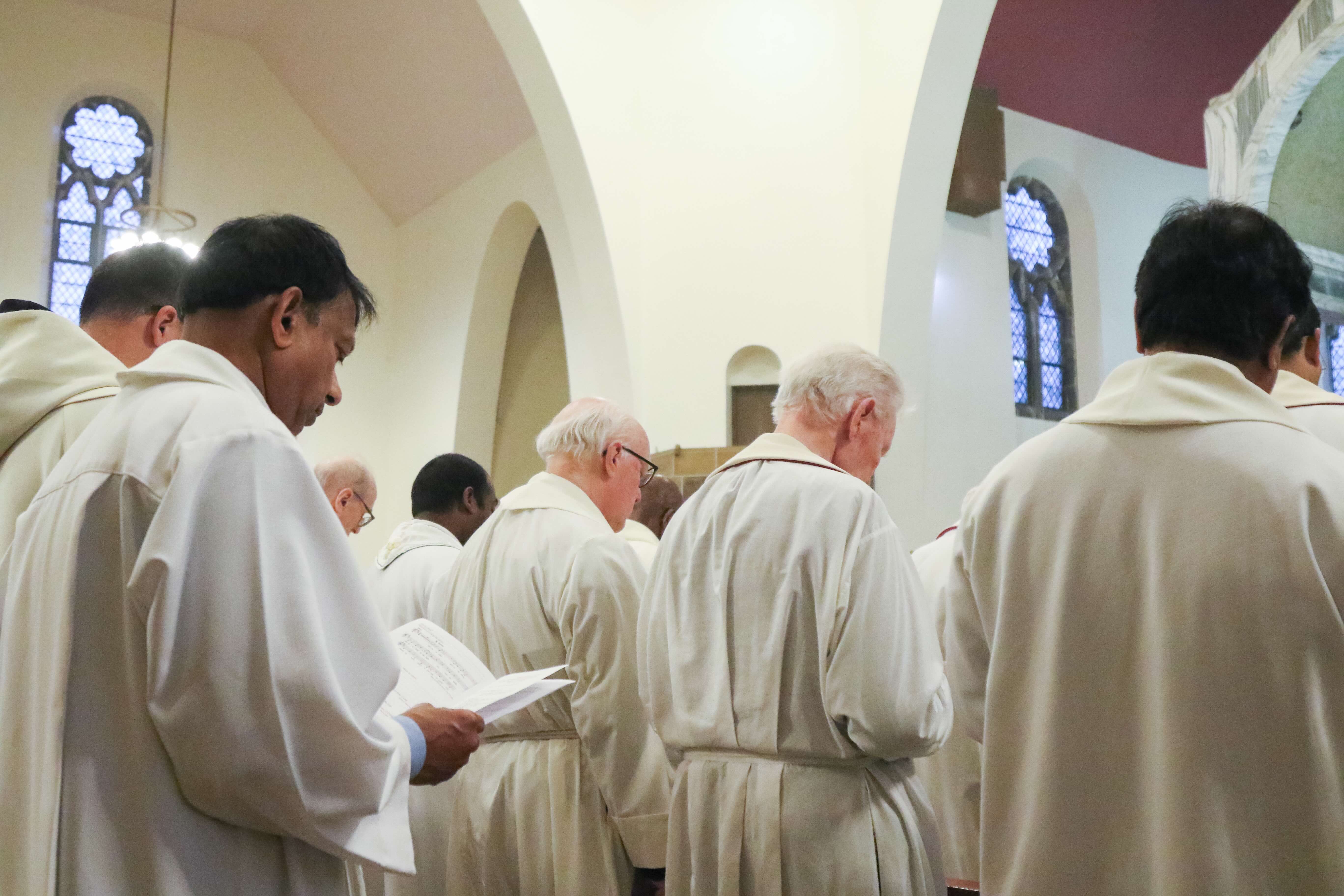
Stand at any Sunday Mass at Shrewsbury Cathedral, at Saint Werburgh's in Chester, or at any parish across the diocese, and you will hear it. After the homily, before the offertory, the people stand. We say together what we believe. The Nicene Creed has been said by the Church, in some form, since the Council of Nicaea in 325, and in its fuller form since the Council of Constantinople in 381. It is older than every bible we own. It is the faith handed down.
The Catechism calls the Creed "the symbol of faith" and explains that "by its very name, the Apostles' Creed reflects the faith of the Apostles" (CCC §§194, 196). To say the Creed is to take your place inside that line.
I believe in one God
The first word matters. Not "we hope" or "we feel" but "I believe." The Creed is a personal act of faith, said with everyone else. The first article (CCC §§198-231) confesses one God, eternal, the source of all that is. The Shema of Israel ("Hear, O Israel: the Lord our God is one Lord", Deuteronomy 6:4) is taken up and held.
The Father almighty, maker of heaven and earth
God is Father, not as a metaphor but as the truth Jesus revealed (Matthew 6:9). He is almighty, the maker of "all things visible and invisible." This means matter is good (CCC §§299, 339). It means your body, the hillside the Cathedral stands on, the orchards above Town Walls, are part of a world he wanted.
And in one Lord Jesus Christ, the Only Begotten Son of God
The longest section of the Creed (CCC §§422-682) is about Jesus. He is "born of the Father before all ages." He is "consubstantial with the Father", which is to say, of the same divine substance. He came down. He took flesh of the Virgin Mary by the Holy Spirit. He became man. The Council Fathers chose every word here against ancient confusions: Christ is not a creature, not a symbol, not a teacher only. He is God from God, true God from true God.
"For our sake he was crucified under Pontius Pilate." The Creed names a Roman governor by name, anchoring our faith in history. "He suffered death and was buried, and rose again on the third day." This is not myth. This is what happened.
I believe in the Holy Spirit, the Lord, the giver of life
The Spirit is "Lord and giver of life" (CCC §§683-747), the third person of the Trinity, "who proceeds from the Father and the Son." The Spirit hovered over the waters at creation, descended on Mary, on Christ at the Jordan, on the Apostles at Pentecost. The Spirit is at work right now in your soul.
I believe in one, holy, catholic and apostolic Church
Four marks (CCC §§811-870). One: there is only one Church of Christ. Holy: she is made holy by Christ, even when her members fail. Catholic: she is for everyone, in every place, of every tongue. Apostolic: she rests on the foundation the Apostles laid.
Bishop Davies has often pressed this point against the wash of cultural voices. In his pastoral letter for All Saints 2025, on Saint John Henry Newman as Doctor of the Church, the Bishop wrote:
"In times when people often despair of finding objective truth, preferring to speak of 'your truth' and 'my truth' because they no longer believe truth can be found, Cardinal Newman has been raised up as a guide."
(Bishop Mark Davies, Pastoral Letter on Saint John Henry Newman, Doctor of the Church, All Saints 2025)
The Creed is the answer to "your truth, my truth." It is the Church's truth, the same in 381, 1851 and 2026.
I confess one Baptism for the forgiveness of sins
One Baptism (CCC §§977-987). It is not repeated. Once you have been buried with Christ in those waters, you are his. This is why the new converts at the 2026 Rite of Election, 171 of them at the Cathedral, mattered so much to the diocese. Each one walked towards a single, lifelong gate.
I look forward to the resurrection of the dead
The last lines (CCC §§988-1060) are almost forgotten by some. We do not look forward only to going to heaven. We look forward to the resurrection of our bodies. We look forward to "the life of the world to come." Newman, in the Cardinal's hat, framed his work this way:
"God has created me to do Him some definite service; He has committed some work to me which He has not committed to another. I have my mission, I may never know it in this life, but I shall be told it in the next."
(Saint John Henry Newman, Meditations on Christian Doctrine)
The Creed ends, as our lives do, with that horizon.
A next step
This Sunday at Mass, listen for the Creed. Do not race through it. Pick one phrase that has gone soft from repetition and pray it slowly all week. Read CCC §§185-1065 across the next month, alongside the Creed itself. The faith that took down the Roman empire, lit Pugin's stained glass at the Cathedral, and brought 171 adults to the font this Easter is the faith you are saying. Stand, and mean it.