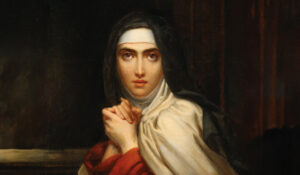
St Teresa of Avila, also known as St Teresa of the Jesus, was a 16th century Spanish mystic, spiritual writer and a theologian of contemplative prayer who in 1970 was declared a Doctor of the Church by Pope st Paul VI. The saint was also a reformer who, along with St John of the Cross, co-founded the Discalced Carmelites in an attempt to restore the strict practices of poverty, solitude and austerity to the Order.
Her books include The Interior Castle, which is considered to be her seminal work; The Way of Perfection, and her autobiography The Life of Teresa of Jesus, the casual reading of which inspired the 20th century martyr and patron saint of Europe St Edith Stein – also known as St Teresa Benedicta of the Cross – to not only convert to Catholic faith but to also become a Carmelite nun herself.
St Teresa of Avila only entered the most fruitful period of her life when, at the age of 40, she underwent a series of profound, extraordinary and deeply mystical religious experiences that brought her into closer unity with Our Lord. They included a sense of her heart being pierced by an angel as well as spiritual espousals and the mystical marriage and they set her single-mindedly on a quest for spiritual perfection.
St Teresa was born in 1515 in Avila in the Castile region of Spain, one of nine children of Alonso Sanchez de Cepeda and his second wife, Beatrice Davila y Ahumada. Even from the age of just seven years the saint would take great pleasure in learning about the lives of the saints and she and a brother, Rodrigo, after reading about the martyrs so wished to emulate them and to unite themselves to God forever that they tried to run away to the “country of the Moors” in the hope that they might die for their faith. An uncle intercepted the pair, however, and returned them to their distraught mother whereupon Rodrigo blamed his sister for their transgression. Martyrdom being out of reach, at least for the time being, the two children tried to build hermitages for themselves so they could imitate the lives of other saints.
But by the time Teresa reached her mid-teens her religious sense had begun to wane and she took an interest in the latest fashions and she wore perfume, for instance. Her father didn’t like this and he sent her to the Augustinian Convent of Santa María de las Gracias de Avila in Avila which was providing educations to other young women of her high social rank.
After about 18 months in the convent her father brought her home because she had fallen sick but by then St Teresa, through reading spiritual books, particularly the classics of Franciscan spirituality, had discovered the sense of a religious vocation and had resolved to be a nun – against her father’s will. Alonso finally gave in when St Teresa reached the age of 20 and she entered the Carmelite Convent of the Incarnation outside Avila, and was professed within a year.
Shortly afterwards, she fell ill, probably from malignant malaria, and suffered for about three years before she recovered. In 1543 her father died and at about the same time each of her siblings emigrated to the Americas. Then the following year, when she was 39, she entered the mystical phase of her earthly life, triggered by the accidental discovery of a statue of Our Lord, grievously wounded.
She was also inspired by a reading of the Confessions of St Augustine of Hippo, and feeling the closeness of another penitent, St Mary Magdalene, Teresa resolved to fix her sights on the pursuit of spiritual perfection.
To this end she felt blessed by many graces from God, including intellectual visions and interior communications. In her autobiography she describes how her mystical experiences intensified. “A feeling of the presence of God would come over me unexpectedly,” she wrote “so that I could in no wise doubt either that he was within me, or that I was wholly absorbed in him”.
Disturbed by some of her experiences she submitted herself to the judgement of the newly-formed Society of Jesus and Father Balthasar Alvarez, who became her confessor, told her that it would be advisable to ask God to direct her to do what was most pleasing to Him.
At this time, St Teresa was beginning to form an ideal of the reform of the Carmelite order and under the guidance of a Franciscan spiritual director, St Peter of Alcantara, she decided to express her spiritual impulses in practical deeds. In 1562 she founded the first reformed Carmel in Avila, with the support of the city’s Bishop, Don Alvaro de Mendoza. Soon afterwards, the saint also received approval from John Baptist Rossi, the Order’s Superior General.
The new community of St Joseph’s was a strict enclosure of almost perpetual silence and nearly absolute poverty, with the nuns wearing habits of coarse serge and sandals instead of shoes (hence the term “discalced”). Compared to the 140 nuns at the Convent of the Incarnation, St Teresa did not wish her fledgling communities to large, and capped the number of nuns at 21. She founded a second house in Medina del Campo, then another at Valladolid and another in Toledo.
It was at Medina that the saint met St John of Cross, a friar enthusiastic about embracing her reforms, and together they established the first Discalced monastery for men at the village of Duruelo in 1568. She continued to open new convents, including at Segovia and Salamanca, founding 17 convents in all.
The Carmelite friars in Italy, meanwhile, were growing afraid of the pace of the reforms and moves began to restrict the activities of St Teresa. The suppression saw St Teresa ordered to choose a religious house and to retire there and also the imprisonment of St John of the Cross in a monastery.
King Philip II of Spain was shocked by their treatment however and he summoned the papal nuncio and rebuked him for his activities. In 1580, an order was obtained from the Holy See to exempt the Discalced Carmelites from the jurisdiction of the mitigated Carmelites. Calced was to separate from Discalced and each order was to have its own provincial. The Discalced Carmelite Order had been born.
Two years later St Teresa died, while still founding new convents. She had just set up a house in Burgos when she fell ill on her way back to Avila. She died at Alba de Tormes on October 15 1582, uttering in her final breaths the words: “O my Lord and my Spouse, the hour that I have longed for has come. It is time to meet one another”. She was buried in Alba de Tormes and she was beatified by Pope Paul V in 1614 and canonised by Pope Gregory XV in March 1622 with Ss Philip Neri, Ignatius of Loyola and Francis Xavier. Along with St Catherine of Sienna, she was the first woman to be declared a Doctor of the Church and she is revered as the Doctor of Prayer.
In a letter of March 2015 to mark the 500th anniversary of the saint’s birth, Pope Francis described St Teresa as “primarily a teacher of prayer”.
“The discovery of Christ’s humanity was central to her experience,” the Holy Father said. “Moved by the desire to share this personal experience with others, she describes it in a vivid and simple way, accessible to everyone, because it consists simply in ‘a relationship of friendship … with he who we know loves us’. Many times this same narrative becomes prayer, as if she had wanted to introduce the reader into her interior dialogue with Christ. Teresa’s prayer was not reserved only to one space or to one time of day; it arose spontaneously in the most diverse occasions … she was convinced of the value of continuous prayer, even if it was not always perfect. The saint asks us to be steadfast, faithful, even in times of dryness, personal difficulties or urgent needs that call us.
Her encounter with Jesus, Pope Francis continued, made St Teresa “a tireless communicator of the Gospel”.
Pope Benedict XVI used a general audience of 2nd February 2011 to also explain something of the contribution this saint has made to the Christian practice of prayer.
The very purpose of her autobiography, the Pope said, “was to highlight the presence and action of the merciful God in her life”.
“For this reason,” the work, written in a convent in Avila in 1565, “often cites her dialogue in prayer with the Lord,” Pope Benedict said, adding: “It makes fascinating reading because not only does the saint recount that she is reliving the profound experience of her relationship with God but also demonstrates it”.
The Way of Perfection, written in 1566, was composed for the 12 novices of the Carmel of St Joseph in Avila and it proposes to them an “intense programme of contemplative life at the service of the Church, at the root of which are the evangelical virtues and prayer. The Interior Castle, written 11 years later, offers the codification of the possible development of Christian life towards its fullness, holiness, under the action of the Holy Spirit.
In his general audience, Pope Benedict said that St Teresa believed that “prayer is life and develops gradually, in pace with the growth of Christian life: it begins with vocal prayer, passes through interiorisation by means of meditation and recollection, until it attains the union of love with Christ and with the Holy Trinity. Obviously, in the development of prayer climbing to the highest steps does not mean abandoning the previous type of prayer. Rather, it is a gradual deepening of the relationship with God that envelops the whole of life.
“Rather than a pedagogy Teresa’s is a true ‘mystagogy’ of prayer: she teaches those who read her works how to pray by praying with them. Indeed, she often interrupts her account or exposition with a prayerful outburst.”
Teresian doctrine also involves the pursuit of spiritual perfection as the aspiration of the whole of Christian life and as its ultimate goal. “St Teresa of Jesus is a true teacher of Christian life for the faithful of every time,” Pope Benedict said. “In our society, which all too often lacks spiritual values, St Teresa teaches us to be unflagging witnesses of God, of his presence and of his action. She teaches us truly to feel this thirst for God that exists in the depths of our hearts, this desire to see God, to seek God, to be in conversation with him and to be his friends.”
St Teresa teaches us that time devoted to prayer is not time wasted, Pope Benedict said, but that it in fact helps our lives to unfold in the love and knowledge of Our Lord and in practical charity for our neighbour.