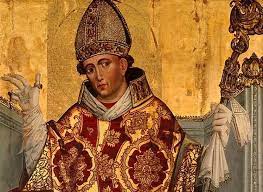
St Stanslaus, the 11th century Bishop of Cracow, was hacked to death by King Boleslaus II of Poland after he excommunicated the monarch for abducting, and refusing to release, the wife of a nobleman.
Stanislaus Szczepanowski was born on 26 July 1030 at Szczepanow to noble parents who had for many years been childless and who believed that the conception of longed-for son came in answer to their prayers.
In gratitude, the devoted him from his birth to the service of God and he was encouraged to follow a life of piety and virtue from his earliest years. He was educated at Gnesen and was later ordained priest by Bishop Lampert Zula of Cracow, who, impressed by his eloquence and saintly example, made him a cathedral canon and also appointed him as his preacher and archdeacon.
Bishop Lampert eventually wished to relinquish his own episcopal ministry so that Stanislaus could succeed him but the priest resisted the idea. On the death of Bishop Lampert, however, he was asked by Pope Alexander II to become the ordinary and he was consecrated bishop in 1072.
His office soon brought him into conflict with Boleslaus, a ruler “whose finer qualities were completely eclipsed by his unbridled lust and savage cruelty”, according to Butler’s Lives of the Saints. Stanislaus was the only bishop apparently courageous enough to upbraid the tyrant and remonstrate with him over the suffering and scandal brought about by his conduct.
The response of Boleslaus was to initially try to excuse his behaviour but when this failed to generate the desired effect he made a measured show of repentance.
He was soon to relapse, however, and committed acts of rapacity and political injustice which again brought him into conflict with the saint.
His abduction of a nobleman’s wife, after unsuccessfully attempting to seduce her, prompted the Polish nobles to lobby the Church to intervene. But the Archbishop of Gnesen and the prelates of the court were too afraid to reproach the King but St Stanislaus visited him and rebuked him for his sin, threatening him with formal censure by the Church.
The King ignored him so he was formally excommunicated by Stanislaus. The King tried to ignore this too but was incensed to discover that the services at the cathedral in Cracow were suspended the moment he entered the building, on the order of the bishop.
Incandescent with rage, he pursued Stanislaus to a small chapel of St Michael, outside of the city, and ordered his guards to kill him. The soldiers emerged from the building complaining that St Stanislaus was celebrating Mass and that he was surrounded by a heavenly light which halted their approach.
At that point the King denounced his men as cowards and seizing a sword entered the chapel and slew St Stanislaus with his own hand. He then ordered his men to chop up the body of the saint into pieces and distribute the parts throughout the countryside so they could be eaten by wild beasts. Most of these sacred relics were recovered by the cathedral canons, however, and buried privately at the door of the chapel where the saint was murdered.
Historians believe the martyrdom hastened Boleslaus’s eventual fall from power, especially as Pope St Gregory VII reacted by laying the country under an interdict. In 1253, nearly two centuries later, St Stanislaus was canonised by Pope Innocent IV.