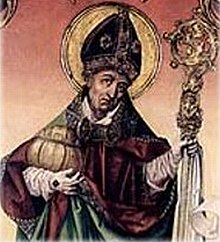
St Rupert was one of the great missionary bishops of Europe, a man who at the end of the 7th century and the beginning of the 8th century dedicated himself to the evangelisation and re-evangelisation the largely pagan people of Bavaria and parts of Austria at the invitation of the local Duke Theodo II.
There is an unproven tradition that he was an Irishman whose Gaelic name was “Robertach” and that he was associated with the monastery of Luxeuil in Burgundy that had been founded by St Columban in 692. Butler’s Lives of the Saints has suggested that the combination of his offices of bishop and abbot “seems to indicate Irish influence”. Other sources have identified him as a Frank of the royal Merovingian family and related to Robertian dynasty.
In any case, before he became a missionary he was already the Bishop of Worms, a diocese from which he may have been expelled by the largely pagan population. He was invited into Bavaria to preach the Gospel by Duke Theodo and arrived in Regensburg in 697. The saint embarked from the town on his first mission. He used the River Danube to travel east, preaching and teaching in towns, villages and forts as far as Hungary, and successfully establishing the faith among people of a huge swathe of territory. He sometimes built on Christian traditions already in place and occasionally adapted heathen temples for Christian worship.
At the conclusion of this first mission, he returned over land and established his headquarters in the ruined Roman town of Juvavum, which was later re-named Salzburg because of nearby salt mines. St Rupert built a church there and dedicated it to St Peter. He built an abbey, also dedicated to St Peter, as well as a convent at Nonnberg and a school. He became first Bishop of Salzburg and laid the foundations for the city’s cathedral.
Shortly afterwards he returned to either Worms or Luxeuil to seek recruits for his missionary work and returned with 12 companions who based themselves in his monastery. Ermentrude, his niece, also agreed to serve as first abbess of the convent he established.
St Rupert then travelled throughout his territory, preaching and building new churches and founding religious communities. Butler’s says that “besides the great work of evangelisation, the saint did much to civilise his converts and promoted the development of the salt mines”.
He returned to Salzburg when he sensed that death was approaching and he breathed his last there sometime between 710 and 720.
He was buried in St Peter’s monastery and in 774 his relics were transferred to the cathedral. The feast day of St Rupert is observed in Ireland and well as in Austria and Bavaria.