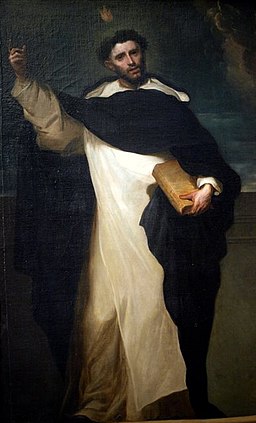
St Vincent Ferrer was a Dominican priest who was instrumental in healing the Great, or Western, Schism of the Latin Church that at one point saw three rival popes competing for the See of St Peter.
He was born in 1350 in Valencia, Spain, the son of William Ferrer, who was either of English or Scottish descent, and Constanza Miguel.
According to Butler’s Lives of the Saints, he parents instilled in him a great love for Our Lord and the Blessed Virgin Mary and for the poor, and he recognised a religious vocation from an early age, joining the Dominicans in Valencia in 1367 at the age of 17.
At the age of 21, he was appointed reader in Philosophy at Lleida, the university in Catalonia, and published two treatises which were considered to be of high merit.
Soon, he was transferred to Barcelona where he was made to preach, even though at the time he was still a deacon.
His superiors grew nervous when he accurately predicted the time of the arrival of ships with a cargo of corn to relieve a famine, and the local people acclaimed him as a prophet, so soon afterwards the saint was moved to Toulouse, France, for a year before he returned to Spain to lecture and preach with “extraordinary success”.
He was able to rouse “multitudes” of lukewarm or lapsed Catholics back to the practice of their faith and to penance and persuaded a number of Jews to become Christians, including Rabbi Paul of Burgos, who died as Bishop of Cartagena in 1435.
St Vincent soon found himself embroiled in the Great Schism which began in 1378 when Urban VI was hastily elected pope by 16 of 23 cardinals in response to local demands for an Italian to succeed Pope Gregory XI.
The cardinals later claimed they had acted under duress so a second conclave was held at which Cardinal Robert of Geneva, a Frenchman, was elected Pope by the full College of Cardinals. He took the name Clement VII and ruled as “anti-pope” at Avignon, France, while Pope Urban reigned in Rome.
St Vincent was among those who believed Clement was the valid pope. On his death it was logical for him to therefore accept as his successor Cardinal Peter de Luna, a distinguished canon lawyer who was also his friend, as Benedict XIII.
The anti-pope summoned Vincent to serve as his adviser and confessor and offered him a bishopric, which he refused. At Avignon, Vincent came to the conclusion, however, that Benedict was resisting attempts to restore unity in the Church, and seemed more intent on defending his own position.
The strain this placed on St Vincent made him ill and when he recovered, he obtained, with great difficulty, permission to leave the court and to work as a missionary.
He left Avignon in 1399 and preached to enormous congregations across France, Switzerland and Italy, visiting first Carpentras, Arles, Aix and Marseilles.
Between 1401-1403, Vincent preached in the Dauphine, in Savoy and in the Alpine valleys, before travelling to Lucerne, Lausanne, Tarentaise, Grenoble and Turin.
In 1405, he preached in Genoa, before he sailed to Flanders where he preached in the Low Countries and gained a reputation for working miracles, with an hour set apart each day for the healing of the sick while he was in the Netherlands.
In 1407, St Vincent returned to Spain and preached the Gospel in territories at that time held by Islamic Moors. Following his visit to Granada, it is said that 8,000 Moors were baptised, and his missions to Seville and Cordoba attracted such huge crowds that they were held in the open air because no church could accommodate them. The saint returned to Valencia after 15 years where he preached, worked miracles and healed dissensions.
The ongoing disunity within the Catholic Church generally was a great source of sorrow to the saint and by 1409 there were three claimants to the papacy. One of them – John XXIII – was deposed by the Council of Constance in 1414.
A proposal was made at the council that the two other claimants should both resign so that one might be elected. Gregory XII, who reigned in Rome, agreed but Benedict resisted, even after St Vincent visited him at Perpignan and asked him to abdicate.
King Ferdinand of Castile and Aragon then summoned the saint to ask for his analysis of the impasse and St Vincent declared that he believed the faithful would be correct in withdrawing their allegiance from Benedict because he was injuring the unity of the Church.
King Ferdinand then withdrew his support for Benedict who was subsequently deposed and the Church was united under a single pope. “But for you,” Gerson wrote to St Vincent, “this union could never have been achieved.”
The saint spent his final years in France, labouring in Normandy and Brittany. In 1419, after he preached a series of sermons in Nantes, he returned to Vannes where it became clear that he was dying, and he expired on the Wednesday of Passion Week, at the age of 70. His death was met with a tide of popular veneration and he was canonised in 1455.