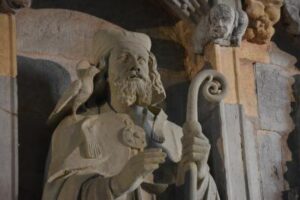
St David, the patron saint of Wales, was a sixth century monk and bishop noted for his abstemious lifestyle and eloquent preaching.
Little is known about his life other than the account recorded by Rhygyfarch in 1090 which is generally accepted to be a mixture of fact and fable and which relied on earlier sources which no longer exist. St David, according to this account, was around born in 520 in Ceredigion and was educated at Henfynyw in Cardigan. He was ordained a priest and studied under the Welsh St Paulinus on an island that has not been identified.
He was said to have founded a succession of monasteries throughout Wales before he finally settled in Menevia (Mynyw) in present-day Pembrokeshire, in the south-west corner of the country.
There he led a community distinguished by their extreme austerity: the monks would plough fields without the help of cattle, drink only water, sometimes mixed with a little milk, and eat only bread and vegetables – a practice which has since linked the saint and his country to the leek (in Shakespeare’s Henry V allusion is made to Welshmen wearing leeks on St David’s day, “an ancient tradition begun upon an honourable respect”).
St David and his followers were equally rigorous in their lives of prayer, keeping a strict vigil from Friday evening to Sunday morning where prayer was maintained continuously with just one hour of interruption, on the Saturday after matins.
After he preached at a synod at Brefi in Cardigan, St David was unanimously elected to lead the Welsh Church. He accepted this on the condition that the episcopal see was transferred from Caerleon to Menevia.
It was because of the Brefi synod that St David is often depicted in art with a bird on his shoulder (the above image is from the mosaic by Ifor Davies in Westminster Cathedral that was blessed by Pope Benedict XVI in September 2010). This is because, according to legend, a snow-white dove descended upon him while he was preaching there.
Although there is a paucity of historical evidence to support it, St David is said to have been active at the synod in suppressing the Pelagian heresy, a belief promoted by the Celtic monk Pelagius which denied the doctrine of Original Sin and held that people had no need of divine grace to obtain salvation.
The saint is alleged to have called a second council at Caerleon which is said to have marked the extirpation of the heresy from Britain.
St David died at his monastery in Menevia in 589. His last words were recorded as: “Be joyful brothers, and sisters. Keep your faith and do the little things that you have seen and heard with me.”
According to Butler’s Lives of the Saints, there can be “no question that he was a highly popular saint in his own country”, with more than 50 churches dedicated to him in South Wales before the Reformation.