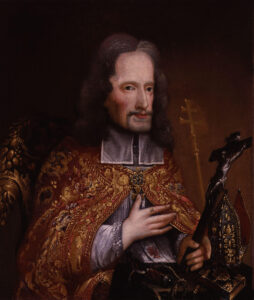
St Oliver Plunkett, Archbishop of Armagh, was the last person to die as a martyr at Tyburn, London, after a persecution of the Catholic Church in the British Isles which started with the Reformation.
He was a victim of the fabricated “Popish Plot” of Titus Oates and was brought to London to stand trial after the state realised that he would never be convicted in his native Ireland. Under the Oates’ narrative, he was accused by renegade priests and others of attempting to overthrow British rule in Ireland with the help of 70,000 French troops. He was continuously promised a reprieve if he agreed to accuse others of involvement in the supposed conspiracy but he went to his death on 1 July 1681 in his archiepiscopal robes and insisting on his absolute innocence.
St Oliver was born in Loughcrew, County Meath, in 1625 into a wealthy landed family of Norman ancestry with aristocratic connections on his mother’s side. He recognised from an early age that he had a vocation to the priesthood and was sent to the Irish College in Rome. Father Pierfrancesco Scarampi, the Oratorian papal envoy, paid his fees and he was a brilliant student.
He was ordained to the priesthood in 1654 but the penal laws in Ireland prevented him from returning home so instead he accepted a post of chaplain to the Oratorian house in Rome. The saint later spent many years lecturing in theology and apologetics at the missionary college of Propaganda Fidei. St Oliver also held a post at the Congregation of the Index and served as the procurator of the Irish bishops.
He was appointed Archbishop of Armagh and Primate of All Ireland in 1669 and consecrated at Ghent on his way back to his home country. Peace had returned to Ireland with the death of Oliver Cromwell and the Restoration of the British throne under Charles II and for a while the saint was able to exercise his ministry without harassment. He was a humble, pious and cheerful man who lived an ascetic lifestyle, and was admired for his integrity and his learning by both Catholics and Protestants alike.
He set about instructing the Catholics of Ireland in the faith and very soon he had confirmed some 10,000 of them. Reforming the clergy proved problematic and his efforts were often met with resistance from secular priests as well as those in religious orders. Diocesan synods and tireless pastoral activity resulted in St Oliver making great strides – but also determined enemies among some of the clergy who opposed him.
A fresh outbreak of religious intolerance in 1673 saw bishops and religious ordered out of Ireland once again and St Oliver went into hiding for seven months and afterwards kept a low profile. The Popish Plot brought full-scale persecution to Ireland at the end of the decade and in December 1679 St Oliver was arrested and taken to Dublin Castle. His accusers included known criminals and “lewd” apostate priests who were notorious among the Irish public and the charges would not stick. So the decision was taken to remove the archbishop to London to stand trial there.
From the outset the prosecution was a monumental miscarriage of justice. The English courts had no jurisdiction over the Irish archbishop, they were trying him twice on the same charges, the statute of limitations had expired, insufficient time was granted for him to bring witnesses to London and his accusers were unreliable, to say the least.
After the guilty verdict had been returned, Sir Francis Pemberton, the judge, sentenced St Oliver to be hanged, drawn and quartered at the end of ferocious rant against the Catholic faith.
St Oliver made his own case to the vast crowd assembled to see him die. He was not made to suffer the full horrors of his execution but cut down from the scaffold only after he was dead.
According to his wishes, his body was initially interred in the churchyard of St Giles, at the eastern end of modern day Oxford Street, where 12 victims of the Oates Plot remain buried, but it was dug up years later and found to be incorrupt. It was taken to a Benedictine abbey in Germany. The head was then carried to Rome before it was taken to Ireland where it is now venerated as a relic in Drogheda. After 200 years, the saint’s quarters were transferred to Downside Abbey, Somerset, where they remain to this day.
The holiness of St Oliver Plunkett was observed by his contemporaries throughout his life. In his final days, fellow prisoner Fr James Corker, a Benedictine priest, marvelled at how he prepared himself with extraordinary composure for martyrdom. What he was to suffer, St Oliver remarked, was but a “flea biting” compared to the sacrifice of Our Lord. The saint was also in constant prayer and fasting about four times a week.
St Oliver was beatified in 1920 and canonised in 1975, the first Irishman to be recognised as a saint since the canonisation of St Laurence O’Toole in the 13th century.