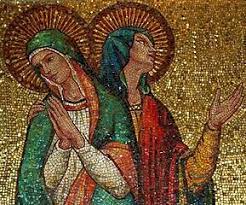
No saints are more uniformly honoured in all the early calendars and martyrologies than Ss Perpetua and Felicity and their four companions, who were martyred together on 7th March 203 in Carthage, in the Roman province of Africa.
The scale of this veneration is owed to the fact that Perpetua, the 22-year-old wife of a man of high position, recorded her arrest, imprisonment and trial in writing while an eye-witness wrote about their deaths.
Perpetua’s writings are punctuated with accounts of the visions that she experienced in jail, which she herself believed to symbolise the battle and triumph over the Devil she and her companions would undergo through their martyrdom. At one point she sees herself as a gladiator fighting an Egyptian, defeating him by stamping on his head, perhaps in an echo of the Book of Genesis.
Such hagiological treasures were so highly esteemed, Butler’s Lives of the Saints tells us, that they were publicly read in churches throughout Africa in the 4th century and that St Augustine of Hippo felt it necessary to protest against their being placed on a level with the Sacred Scriptures.
The martyrs were indeed truly heroic. At the time of her arrest Perpetua was nursing a baby and Felicity, a slave, was eight months pregnant. Both were catechumens, along with Saturninus, Secundulus and Revocatus, who were arrested with them. A fourth man, Saturus, joined them in prison.
Before her trial Perpetua’s father pleaded with her to abandon her faith but she rebuked him by saying: “I cannot call myself by any other name than what I am – a Christian.”
The judge, Hilarian, later asked her outright: “Are you a Christian?”
“I am,” she answered.
All six were condemned to death by wild beasts at a festival in the amphitheatre at Carthage. Secundulus died in prison beforehand and Felicity gave birth to a daughter in prison who was adopted by fellow Christians.
On the day itself, the men led the way into the arena followed by Perpetua and at her side Felicity “rejoicing to come from the midwife to the gladiator, to wash after her travail in a second baptism”.
Saturninus and Revocatus were the first to die after they were set upon by a leopard and then a bear.
A wild boar was loosened upon Saturus but it turned on its handler, killing him instead. The martyr was then tied up for a bear but it refused to come out of its pen. Finally, he was killed with a bite to his throat by a leopard but as he lay bleeding was able to encourage the gaoler Pudens, who had converted to Christianity, with the words: “Keep the faith and me in mind and don’t let these things confound you, but confirm you.”
Finally, the two women were thrown before an angry bull which wounded them but failed to kill them. They were stabbed to death by gladiators in front of the roaring crowd, with Perpetua guiding the executioner’s sword to her throat after his first botched attempt: the saint’s final recorded words were to her brother and the catechumen Rusticus. “Stand fast in the faith and love one another,” she said, “and don’t let our sufferings be a stumbling block to you.”
The bodies of the six were eventually interred in the Basilica Majorum in Carthage, a city which is today a suburb of Tunis, the capital of Tunisia.
The ruins of the amphitheatre where they were martyred can still be visited today though it is not generally part of most tourist itineraries.