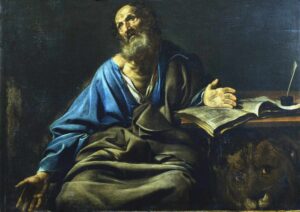
St Mark the Evangelist is the author of the second Gospel. This book was probably the first of the four to have been written and is the shortest of them. It opens in the desert with an account of the preaching of St John the Baptist and a third of the text is concentrated on the events surrounding the crucifixion of Jesus Christ.
St Mark may have written the Gospel in Rome in the Year 65 (tradition places him there with St Peter) though it has also been suggested that it might have been written in Alexandria in 70 before the destruction of the Temple in Jerusalem.
Little is known about the life of St Mark. It has been supposed he is the person who escapes from the soldiers arresting Jesus by wriggling out of his clothes and running away naked since this account is included only in his Gospel. There is also the tradition, dating from at least the second century, that Mark was among the 72 disciples who were sent out to preach the Gospel by Jesus.
“John surnamed Mark” is referred to in the Acts of the Apostles though there has been some confusion over whether this man is the Evangelist. There are references to Mark in St Paul’s Letter to the Colossians where he is described as a kinsman of St Barnabas, who, according to the Acts was a Levite and a Cypriot. St Mark’s Gospel, written in the fluent Greek typical of the Eastern Mediterranean and with topographical errors about the landscape, indeed suggests that the author was not a Palestinian. Roman Martyrology tells us he was born in Alexandria.
St Paul and St Barnabas were accompanied by “John surnamed Mark” during their apostolic mission to Salamis in Cyprus but when they arrived at Perga in Pamphylia he left them and returned to Jerusalem. This appears to have upset St Paul because he would not include Mark in his plans to visit the churches of Asia Minor. St Barnabas, however, desired his company and opted to separate from St Paul to travel back to Cyprus with Mark. Nevertheless, during his second captivity in Rome, shortly before he was beheaded, St Paul wrote to Timothy, then at Ephesus, enjoining him to “take Mark and bring him with you, for he is profitable to me for the ministry”.
A tradition, dating from at least the second century, strongly testifies that St Mark was most closely associated with St Peter. Clement of Alexandria, Irenaeus and Papias speak of Mark as the “interpreter” or mouthpiece of the Apostle, a disciple who accurately wrote down his memories. St Peter himself concludes his First Letter, written from Rome, with a reference to “my son Mark”, who was there with him.
Roman Martyrology tells us that eventually St Mark returned to the city of his birth to preach the Gospel and to establish Alexandria’s first church. He was arrested for his faith, tortured by being dragged over stones and was said to have been comforted in prison by an angel. He was finally martyred near Alexandria in the “eighth year of Nero”.
He remains were transported from Alexandria to Venice in the ninth century to protect them from desecration by marauding Arabs and the Italian city has been closely associated with the Evangelist ever since.
St Mark is honoured as principal patron of the city. St Mark’s Cathedral in Venice has 12th and 13th century frescoes showing supposed scenes from his life and his symbol, a winged lion (based on the visions in Ezekiel and Revelation) was adopted by the Republic of Venice and used increasingly as the city grew in prosperity. St Mark is also the patron saint of Egypt, notaries, basket-weavers, glass workers and opticians.
(Source: Butler’s Lives of the Saints)