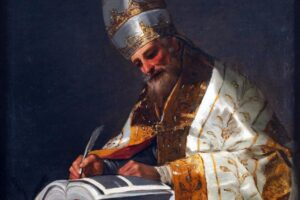
St Gregory is one of only three popes to have been accorded the title “Magnus” – the Great – the others being Pope Leo I and Pope Nicholas I. He is one of the four Doctors of the Church in the West and he reigned as pope from 590 to 604. He was the first monk to be proclaimed as the Successor of St Peter and it was he who in 596 dispatched St Augustine of Canterbury, a monk from his own community, to evangelise the English after he saw Anglo-Saxon slaves in a Roman market and made the famous remark: “Non Angli sed angeli” (not Angles but angels). Indeed, St Gregory the Great was a man very close to the English people and to the Order of St Benedict: nearly everything of what we know about the life of our founding Father originates from The Dialogues of St Gregory.
So who was St Gregory? He was born in 540 into an extremely wealthy and distinguished patrician Christian family which had already produced two popes – Felix III, who reigned from 483 to 492, and Agapetus, the great-great grandfather of St Gregory who reigned for just one year from 535. His parents, Ss Gordian and Sylvia, inspired Christian ideals in the boy at an early age as he grew up in a magnificent house on the Clivus Scauri.
St Gregory followed his father into a career of public administration and in 572 he became the Prefect of the city of Rome. His father died the following year, leaving him vast estates in Italy and Sicily. St Gregory handed these over to the Church and he also established seven monasteries, including one in the family home on the Coelian Hill, which he dedicated to St Andrew and where he chose to live as a monk.
The period of monastic life, in which he entered into a permanent dialogue of love with God, became a source of strength for the challenges of the future, with his insights gained at that time providing the substance for many of his homilies. It was a happy period for the saint, and one in which he was immersed in an ever deepening understanding of Sacred Scripture and the teachings of the Fathers of the Church.
It was not long, however, before he was summoned from the monastery by Pope Pelagius II who needed his abilities and experience to help to solve many of the problems beleaguering Rome. The pope appointed him one of the seven deacons of Rome, with the rank of cardinal, and he was also ordained a priest.
Pelagius then sent him to Constantinople as papal apocrisiarius – an office similar to that of a nuncio – in an attempt to overcome the last gasps of the Monophysite controversy but rather crucially to ensure the Emperor’s assistance against Lombard invaders who were threatening Rome at that time.
After some years the saint was recalled to Rome where he was elected abbot of his former monastery and where Pelagius also appointed him as his secretary. It was a turbulent period marked by floods and famine and then by plague, with Pope Pelagius in 590 among the many people killed by the disease. On the death of the Pontiff, the city immediately turned to St Gregory, with the clergy, people and senate unanimous in choosing him as successor. He was very reluctant to accept the petrine office, even attempting to flee, but eventually he yielded and he became pope on 3rd September of that year.
St Gregory proved instantly effective in his execution of both ecclesial and civil affairs. He assured Rome’s food supplies by reorganising estates owned by the papacy in Europe and North Africa, known as the “patrimony of Peter”, and making sure they were properly run by the appointment of managers who guaranteed not only that they were productive but that they were run with “absolute rectitude and according to the rules of justice and mercy”.
The most pressing issue immediately facing him, however, was the “Lombard question” and Gregory made every possible effort to bring about a peaceful solution to the constant threat posed to Rome by her northern neighbours, and this included their evangelisation. The saint showed equal concern for the preaching of the Gospel throughout the emerging new Europe. He was keen that the Visigoths of Spain, the Franks, the Saxons and the tribes of Britain, for instance, each received the Word of God and it was in this context that he sent monks from Rome to evangelise the people of England.
St Gregory was described as a “true peacemaker” by Pope Benedict XVI in a general audience of 2008, a pope who “deeply committed himself to establish an effective peace in Rome and in Italy by undertaking intense negotiations with Agilulf, the Lombard King”.
The fruits of these nine years of labour were a truce that lasted for about three years after which, in 603, it was possible to stipulate a more stable armistice and also to permit the evangelisation of the Lombards themselves. St Gregory therefore achieved the remarkable feat of establishing peace and understanding on a diplomatic-political level while spreading the true faith among non-Christian peoples.
St Gregory also showed great kindness to the Jewish people and he would not allow them to be harassed, oppressed or deprived of their synagogues. When this did happen, such as the time when the Jews of Cagliari complained that their synagogue had been seized by a convert Jew and changed into a church, the pope ordered the building to be restored to the community from whom it had been taken.
As a monk, St Gregory was strongly influenced by the Rule of St Benedict and Butler’s Lives of the Saints tells us that the saint did “more than anyone to pass its spirit on to medieval monasticism”. The saint took a keen interest in the liturgy and composed at least some of the prayers in the Gregorian Sacramentary and he personally oversaw the musical development of the Gregorian Chant.
He wrote extensively and perhaps his best known work is the Regula Pastoralis, a book on the episcopal ministry that contends that the role of a bishop is foremost a physician of souls and the enforcement of discipline. A bishop, he tells us, must above all be the “preacher” par excellence, an example for others whose behaviour may also be a point of reference for all.
The final chapter of the Rule is dedicated to humility, a virtue which St Gregory was eager for bishops to cultivate. “When one is pleased to have achieved many virtues, it is well to reflect on one’s own inadequacies and to humble oneself,” he wrote. “Instead of considering the good accomplished, it is necessary to consider what was neglected.”
There is also a Register of more than 800 extant letters written by the saint, along with many writings of an exegetical character, including his Morals, a commentary on the Book of Job, his Homilies on Ezekiel and the Homilies on the Gospel. In his general audience of 4th June 2008, Pope Benedict notes that St Gregory “never sought to delineate ‘his own’ doctrine, his own originality. Rather, he intended to echo the traditional teaching of the Church, he simply wanted to be the mouthpiece of Christ and of the Church on the way that must be taken to reach God. His exegetical commentaries are models of this approach”.
The Dialogues, written by Gregory for the edification of the Lombard Queen Theodolinda, is a book of hagiographical character. It is outwardly addressed to his friend Peter, the deacon, who, according to Pope Benedict, “was convinced that customs were so corrupt as to impede the rise of saints as in times past … (but) Gregory demonstrated just the opposite: holiness is always possible, even in difficult times.”
Book II is wholly dedicated to the figure of St Benedict of Nursia, the founder of the Order of St Benedict, and it is the only ancient witness to his life.
In spite of his inclination toward peace-building, St Gregory endured an often fraught relationship with the Patriarch of Constantinople, particularly over his claim to the title of “ecumenical” or “universal”. His concern was primarily for the fraternal unity of the universal Church, Pope Benedict tells us. “Above all he was profoundly convinced that humility should be the fundamental virtue for every bishop, even more so for the patriarch.,” he explained. “Gregory remained a simple monk in his heart and therefore was decisively contrary to great titles. He wanted to be – and this is his expression – servus servorum Dei (Servant of the Servants of God). Coined by him, this phrase was not just a pious formula on his lips but a true manifestation of his way of living and acting. He was intimately struck by the humility of God, who in Christ made himself our servant. He washed and washes our dirty feet. Therefore, he was convinced that a bishop, above all, should imitate this humility of God and follow Christ in this way. His desire was to live truly as a monk, in permanent contact with the Word of God, but for love of God he knew how to make himself the servant of all in a time full of tribulation and suffering. He knew how to make himself the ‘servant of the servants’. Precisely because he was this, he is great and also shows us the measure of true greatness.”
Pope St Gregory the Great died on 12th March in the year 604. Among his last actions was to send a warm winter cloak to a poor bishop who suffered from the cold. He was buried in St Peter’s and on his tomb reads the epitaph: “After having confirmed all his actions to his doctrines, the great consul of God went to enjoy eternal triumphs.”
He was quickly acclaimed as a saint in both the West and the East and many churches in England, Ireland and elsewhere are dedicated to him. He has often been represented in art and during the Medieval period he was frequently depicted as a saint writing as the Holy Spirit dictated to him.
In the 15th and 16th centuries the Mass of St Gregory was portrayed in art too, showing the Crucified Christ appearing while the saint celebrated Mass in an emphasis on his belief in the Real Presence.
St Gregory is today venerated as a patron saint of musicians, singers, teachers, students, masons and of Ecuador.