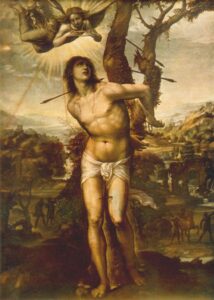
St Sebastian was a Roman martyr who died in the persecution of the 3rd century Emperor Diocletian who ordered him to be shot with arrows. He is now venerated as the patron saint of soldiers, archers and people stricken by plague.
His acts date from the fifth century and some scholars have suggested that much of them amount to little more than a “pious fable”, according to Butler’s Lives of the Saints. What is not disputed, however, is that St Sebastian died a martyr for the faith in Rome and that he was venerated in Milan, a city to which he also had a connection, even during the time of St Ambrose. He was buried on the Appian Way outside of Rome and a basilica was built in dedication to him at the site of burial.
According to his acts, St Sebastian was born in Narbonne in Gaul to Milanese parents and he grew up in Milan. He was a fervent Christian even before he entered the Roman army in 283 during the rule of the Emperor Carinus.
He personally exhorted some of the Christians, whose persecution he was witnessing, to constancy in the face of their sufferings. Their subsequent heroic example of these Christians led to the conversions of 16 fellow prisoners, their gaoler, and eventually that of Chromatius, the governor of Rome, who, following his baptism, released the captive Christians before he resigned his prefectship.
Diocletian became Emperor after he defeated and slew Carinus in Illyricum, and his made Maximian his colleague in the empire. Ignorant of Sebastian’s religious convictions but an admirer of his courage and character, Diocletian promoted the saint to the rank of captain of a company of Praetorian Guards.
In 286, the Diocletian persecution intensified and a number of Christians close to Sebastian were martyred by such methods as burning, stoning, beheading, drowning, by being buried alive and by being shot through with arrows.
Eventually, St Sebastian himself was impeached by Diocletian who reproached him furiously for his alleged ingratitude before delivering him to death at the hands of a company of archers from Mauritania.
The saint is often depicted in art tied to a post, his body pierced with arrows. His acts record that he survived this ordeal, however, and that Irene, the widow of St Castulus, found him still alive when she went to bury him. She took him to her lodgings and nursed him back to some measure of health.
St Sebastian insisted not only on remaining in Rome but also in returning to his post. He took up station on a staircase along which he knew Diocletian would pass and there he accosted the Emperor, denouncing the abominable slaughter of Christians and other cruelties he was exacting against them.
The stunned Diocletian was said to be speechless when confronted by a man he believed to be dead but he recovered his nerve and order St Sebastian to be beaten to death with cudgels and his body thrown into a common sewer. It was recovered by a woman called Lucina, whom the saint had rebuked in a vision, and secretly buried at a place called ad catacumbas, the site of the Basilica of St Sebastian.