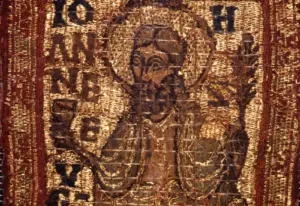
St Cuthbert was a Briton who was born around the year 636 either in the north of England or the Scottish lowlands. By the age of eight years he was being raised by a widow, Kenswith, as if he was her own son. At that age he was like many other healthy boys and was described by Butler’s Lives of the Saints as a “lively little lad, full of fun, and the ringleader of the boys of the countryside”. But there is also an anecdote that in their midst of all their rough and tumble a child burst into tears and exclaimed: “Oh, Cuthbert, how can you waste your time in idle sport – you whom God as set apart to be a priest and a bishop?”
Cuthbert later became a shepherd and in the solitude of the great pastures of Northumbria he grew ever closer to God. There, at the age of 15, he decided to consecrate his life to the Lord after he received a vision of a dazzling light across the dark sky and angels carrying a soul to heaven in the shape of a blazing orb. Later he learned that St Aidan had died that same night.
Soon afterwards St Cuthbert, armed with a spear, arrived by horseback at the gate of Melrose Abbey and asked to be admitted to the brethren.
Cuthbert chose Melrose ahead of the more prominent Lindisfarne because of the esteem he had for the prior, Boisil, whom he considered a “priest of great virtues and prophetic spirit”. Boisil urged the abbot, Eata, to accept him and Cuthbert soon became an exemplary monk.
In 660, three years before the Council of Whitby, Eata asked him to be guestmaster of a new religious house at Ripon, North Yorkshire, founded on land given by King Alfric. But after the famous dispute over the date of Easter, the king transferred the new abbey to St Wilfrid and Eata and his monks, including Cuthbert, soon returned to Melrose.
There Cuthbert was elevated to prior following the death of Boisil from a plague that was ravaging the countryside. The crisis was also triggering a reversion of many people in the region to earlier pagan ways and superstitions, so the saint embarked on a taxing but successful missionary project to win them back to Christianity, travelling from house to house in even the most remote hamlets between Berwick and Solway Firth to preach the Gospel.
When St Colman resigned as Abbot of Lindisfarne and withdrew to Ireland with dozens of the monks who, like him, would not accept the Roman use of determining Easter, Eata was named as his replacement and also consecrated bishop – and he made Cuthbert his prior at Lindisfarne. Cuthbert laboured among the people and developed a reputation as a healer both of bodies and of souls.
He yearned for solitude, however, and after some years retreated to his first hermitage at St Cuthbert’s Isle, an islet of Holy Island, where he lived on barley and a spring of fresh water. Visitors persisted in coming and Cuthbert finally built a guest house for them, but he left his retreat only once in nine years and that was at the request of St Elfleda, the daughter of King Oswy, who urged him to accept the bishopric of Hexham, which he did, very reluctantly. St Eata, Bishop of Lindisfarne, arranged for an exchange of bishoprics so that Cuthbert would remain in charge of the Lindisfarne monastery.
On Easter day 685 Cuthber was consecrated at York Minster by St Theodore, Archbishop of Canterbury, and as a bishop preached, taught, distributed alms and wrought so many healing miracles that he was nicknamed the “wonderworker of Britain”. Defeat in war followed by a plague again set him on foot preaching the Gospel among the troubled people of his diocese.
St Cuthbert himself was growing weaker, however, and during his second visit to Carlisle, he told St Herbert, the hermit of Derwentwater and his former disciple, that they would meet on earth no more. He made a farewell visitation of his diocese and after celebrating Christmas of 686 with the monks of Holy Island he laid down his pastoral staff and retreated to his beloved Farne for his final three months. His last instructions were given to Abbot Herefrid who had requested a message for the brethren.
“Be of one mind in your councils, live in concord with other servants of God,” St Cuthbert said. “Despise none of the faithful who seek your hospitality, treat them with kind charity, not esteeming yourselves better than others who have the same faith and often live the same life. But hold no communion with those who err from the unity of the Catholic faith. Study diligently, carefully observe the canons of the fathers and practise with zeal that monastic rule which God has deigned to give you by my hands. I know that many have despised me, but after my death it will be found that my teaching has not deserved contempt.”
The saint then received the last sacraments and he died peacefully, seated, with his hands uplifted and his eyes gazing toward the sky.
This moment, on 20th March 687, was the end of an earthly life of “almost continuous prayer”. According to Butler’s Live of the Saints, “all that he saw spoke to him of God, and his conversation was about heavenly things”.
St Bede said: “He was aflame with the fire of divine charity, and to give counsel and help to the weak he considered equal to an act of prayer – knowing that He who said, ‘Thou shalt love the Lord they God’ also said ‘Thou shalt love they neighbour as thyself’.”
For the next 188 years he remains were kept at Lindisfarne Abbey but in ensuing centuries were transferred regularly to different locations across the north to protect them from the Vikings. In the 10th century his body was enshrined in Durham Cathedral where it remained until his tomb was desecrated during the Reformation. Afterwards, his remains – still said to be incorrupt in 1539 – were secretly buried in the same place. They were rediscovered and his grave was opened twice during the 19th century.
St Bede is sometimes depicted carrying the head of St Oswald, which was placed in his coffin with him for safe-keeping and was discovered there when it was opened in 1104. He is also sometimes shown with one of “St Cuthbert’s birds”, the wildfowl that swarmed in the Farne islands. He is occasionally also shown followed by otters he is said to have befriended during his missionary ventures.
Two ancient copies of the Gospels are closely associated with St Cuthbert – the 8th century Lindisfarne Gospel that was laid on his tomb, and the 7th century Gospel of St John buried with him. More than a hundred churches are dedicated to him in England alone. His ring was among the most treasured possessions of Ushaw College, Durham.
Cuthbert is the patron saint of Durham and a dense fog that saved the city from Nazi bombers in the Second World War has been attributed by some to his intercession.