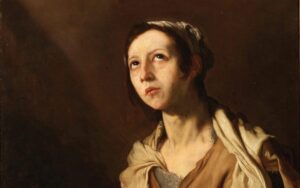
St Mary of Egypt is the patron saint of penitents, having abandoned an extremely dissolute lifestyle for the hermetical life of prayerful solitude and penance after experiencing the mercy of God.
From the age of 12 years old she lived as a prostitute “not for money, but to gratify her lusts”, according to Butler’s Lives of the Saints, but she underwent conversion at the age of 28 after she gazed upon an icon of the Blessed Virgin Mary.
The experience led her to retreat into the Jordanian desert where she lived as an ascetic for the following 47 years, learning the mysteries of faith “from God himself”.
What is known about her life comes mostly from an account written by St Sophronius, the 7th century Patriarch of Jerusalem, based upon an oral tradition.
Born in Egypt in the 5th century, St Mary ran away from the family home for Alexandria and was immediately seduced into a life of sin and excess.
She was drawn by curiosity to join a pilgrimage to Jerusalem for the Feast of the Exaltation of the Holy Cross, and corrupted many pilgrims en route. But when she reached the Church of the Holy Sepulchre she felt barred from entry by an unknown force. For the first time in her life, the enormity of her sins suddenly dawned upon her. At that point she raised her eyes and she saw the icon of Our Lady and, weeping, vowed to undertake a life of penance. It was only then that she was able to enter the church.
After venerating a relic of the true cross, St Mary returned to the icon to give thanks to Our Lady when she heard a voice telling her: “Go over the Jordan and you shall find glorious rest.”
She travelled first to the monastery of St John the Baptist where she received absolution for her sins and received Holy Communion, and then she headed into the wilderness. There she lived on dates and edible plants and for the first 17 years was tested by a barrage of spiritual assaults both night and day. She had contact with neither the outside world nor any person for more than four decades.
It was in the desert, beyond the River Jordan, that many years later St Mary was discovered in a cave by St Cyriacus and his followers, according to the writings of Cyril of Scythopolis, a member of the group.
She told two of his disciples who approached her to keep away because she was a woman and naked but informed them her name was Mary, that she had once been a singer and actress and that she was living in the desert to atone for the sins of her previous life. On the occasion of a second visit, the group found her dead and buried her on the spot.
The account of St Sophronius adds that St Mary related her story to a priest called Zosimus of Palestine, who clothed her with his mantle, and who gave her the Blessed Sacrament beside the Jordan a year before her death. According to this narrative, which was held to be true by St John of Damascus, it was Zosimus who buried her – with the help of a passing lion, which used its claws to dig her grave.
Besides the patron saint of penitents, St Mary of Egypt is also considered to be a patron saint of chastity and is invoked in warfare against temptations of the flesh, deliverance from carnal passions, and deliverance from demons, fever and skin diseases.