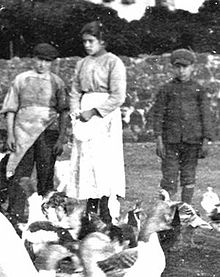
Described by Pope Pius XII as the “St Agnes of the 20th century”, St Maria Goretti was an 11-year-old girl who was stabbed to death after she resisted a man who tried to rape her. As she fought against her assailant, she told him that he was committing a mortal sin and she pleaded with him to think of his own soul. She forgave her murderer as she died in hospital and he later converted to the Catholic faith after he saw her in a dream approaching him with her arms full of lilies, a flower which in Catholic iconography symbolises virginity and purity. Some 48 years later after the murder, the attacker, Alessandro Serenelli, attended her canonisation by in St Peter’s Square and today, St Maria is invoked as a patron saint of rape victims and teenage girls.
She was the third child born to a family of peasant farmers who lived near Ancona on Italy’s Adriatic coast. They were so poor that by the time she was six years old they had to give up their farm and work for other farmers, moving to two other locations until in 1899 they set up in a residence above a barn in Nettuno in Lazio which they shared with the Serenelli family. Maria’s father died from malaria when she was nine years old and while her mother and most of her siblings were working in the fields she would remain at home, cleaning the house and cooking and sewing.
The family had a deep faith and Maria, who was not given a formal education, was sent to a Sunday school run by the Passionists so she could make her First Holy Communion in May 1902. Thereafter she was a regular recipient of the Blessed Sacrament.
When the Goretti and the Serenelli families first began to live together, Alessandro related to Maria as an elder brother. But by 1902, then aged 19, he began to make sexual advances toward her. These became increasingly violent and Maria fought off two attempted rapes, which she kept secret, before he found her alone at home on July 5 and dragged her inside at knifepoint and tried to rape her for a final time.
As she fought him, she protested to him that he would be committing a mortal sin and would go to hell. “No! It is a sin!” she screamed, “God does not want it!” He began to choke her but she told him that she would rather die than to give in to him. Alessandro then stabbed her 11 times. In spite of her injuries St Maria fought her way to the door so her attacker stabbed her another three times to stop her from escaping. The knife punctured her throat, her heart and her lungs.
St Maria was discovered by Alessandro’s father and she was rushed to hospital in Nettuno while police arrested her attacker as he tried to run away.
Given the extent of her injuries surgeons were surprised that St Maria was still alive and they operated upon her immediately and without an anaesthetic. She was able to survive a further 24 hours, during which she told of Alessandro’s sexual harassment and said she had been too scared to tell her family of his previous attempts to rape her. She also said that she forgave him and that wanted him to be in heaven.
She received the Blessed Sacrament for the last time and died while gazing at a picture of the Blessed Virgin Mary as she held a crucifix to her chest.
Alessandro initially refused to show any remorse for his crime, which he openly admitted, and was sentenced to 30 years in jail, being considered too young to qualify for capital punishment. For the following three years, he was uncommunicative and showed no signs of repentance.
This changed when he was visited by a local bishop to whom he described his dream about the saint. On his release, he visited Maria’s mother Assunta and begged her for forgiveness, which she gave him. They later attended Mass together. Alessandro went on to become a Franciscan lay brother and he worked as a receptionist and a gardener at a monastery where he died in 1970 at the age of 87 years.
Miraculous healings attributed to St Maria’s intercession resulted in the swift progress of her cause and her mother became possibly the first in history to attend the canonisation ceremony of her child. Half-a-million other people also travelled to Rome for the ceremony performed by Pope Pius XII.
“Young people, pleasure of the eyes of Jesus, are you determined to resist any attack on your chastity with the help of grace of God?” the Pope asked the crowd. The roar of the word “yes” was the reply that came back to him.