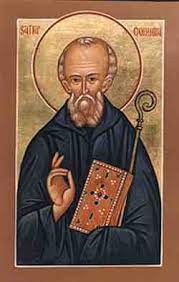
St Columba was a 6th century Irish abbot and missionary who led the evangelisation of the Scotland, and particularly of the Picts of the north. Along with St Patrick and St Brigit, he is venerated as one of the three most important Irish saints and is also considered to be one of the “Twelve Apostles of Erin”. He is also famous for founding the abbey at Iona, which has served as a centre for Christianity for centuries, and which remains a place of pilgrimage and retreat today.
St Columba, also known as “Colmcille”, was born at Gartan in County Donegal in 1521. His father, Fedlimid, was a great grandson of Niall of the Nine Hostages, an Irish high king of the 5th century, and his mother, Eithne, was descended from a king of Leinster and was related to the princes of Scottish Dalriada.
He was baptised by his priest guardian and raised by him at Temple Douglas before he was sent to various monastic schools. He was ordained deacon at Moville and a priest at Clonard before he returned to his native Ulster at the age of 25 years.
St Columba spent the following 15 years travelling throughout Ireland preaching the Gospel and founding monasteries, chief of which were those at Derry, Durrow and Kells. A scholar who loved books, he was embroiled in controversy when St Finnian demanded the copy of St Jerome’s psalms he had made for himself from his own. St Columba refused, so St Finnian appealed to King Diarmaid, the overlord of Ireland, who ordered him to surrender it. “To every cow her calf,” said the judgement, “and to every book its son-book. Therefore the copy which you have made, Colmcille, belongs to Finnian”.
St Columba was soon to find himself more grievously at odds with the king after Curnan of Connaught took refuge with the saint after he killed a man during a hurling match. The king’s men dragged him from St Columba’s arms and slaughtered him in defiance of the rights of sanctuary. This triggered a war between Columba’s family and the king which culminated in the Battle of Cuil Dremne, which claimed the lives of 3,000 people.
St Columba was held morally responsible for the bloodshed and was censured at the synod of Telltown. He would probably have been excommunicated if St Brendan had not intervened to save him. St Columba’s conscience was uneasy too, according to Butler’s Lives of the Saints, and he took the advice of St Molaise to do penance by exiling himself from his mother land while attempting to win for Christ as many souls as had perished on the battlefield.
Butler’s notes that this is the traditional account of St Columba’s departure from Ireland and that it is “probably correct in the main”. St Adamnan, his earliest biographer, is silent on such motives and attributes the evangelisation of Scotland solely to missionary zeal and to the love of Christ, and at the invitation of Conall, the King of the Scottish Dalriada, who was also one of Columba’s relatives.
In any case, St Columba, then aged 42, sailed for Scotland with a dozen of his relatives in a wicker and leather coracle in 563 and on the eve of Pentecost landed on the isle of Iona, where he set about building the monastery that would be his home for the rest of his life. Initially, the saint worked among the imperfectly instructed Christians of the Scottish Dalriada, who lived to the south and west of the Grampians, and most of whom were of Irish descent, before he struck north and east towards the Picts, who were druidic pagans.
Accompanied by Ss Comgall and Canice he made his way to the castle of Pict King Brude at Inverness, but he was forbidden entry until he raised his arms and made the sign of the cross. Greatly impressed by the saint, King Brude soon became a convert and St Columba and his followers preached the Gospel at Ardnamurchan, Skye, Kintyre, Loch Ness, Lochaber and probably Morven, as well as Aberdeenshire.
St Columba continued to stay in contact with Ireland and he was present at the Synod of Drumceat in Meath in 575. His headquarters by then were permanently at Iona, however. He was an abbot with a reputation for holiness and he was visited regularly by Christian pilgrims, including those seeking healing and counsel.
He died at Iona in 597 shortly after he was discovered in the abbey church one morning, stretched out before the altar, at the end of a four-year illness. After weakly blessing his brethren he breathed his last.
Before he died, he left this prophecy about Iona: “Unto this place, small and mean though it be, great homage shall yet be paid, not only by the kings and peoples of the Scots, but by the rulers of barbarous and distant nations with their peoples. The saints, also, of other churches shall regard it with no common reverence.”
As a young man, St Columba was described as being of athletic build and possessing a voice “so loud and melodious it could be heard a mile off”. He was renowned for his austerity of life, rather than for gentleness, yet as he entered into the twilight of his life he became ever more serene, spending much of his time transcribing books and writing poetry.
St Adamnan wrote his biography of the saint some 30 years after Columba’s death. Having never met him, it was based on the recollections of those who knew the saint and who clearly believed in his sanctity.
“He had the face of an angel,” wrote St Adamnan. “He was of an excellent nature, polished in speech, holy in deed, great in counsel. He never let a single hour pass without engaging in prayer or reading or writing or some other occupation.
“He endured the hardships of fasting and vigils without intermission by day and night, the burden of a single one of his labours would seem beyond the powers of man. And, in the midst of all his toils, he appeared loving unto all, serene and holy, rejoicing in the joy of the Holy Spirit in his inmost heart.”
St Bede, some 66 years after the death of St Columba, testified to the holiness of the monks of Iona, describing them as “distinguished for their purity of life, their love of God, and their loyalty to the monastic rule”.