To be described as “one of the diamonds of England” would be high praise indeed, even if it came from a close friend.
But when the person who plans your murder pays you such a compliment then it cannot be dismissed as flattery. In this instance England’s diamond was St Edmund Campion and the tribute came from Lord Burghley, Queen Elizabeth I’s Secretary of State.
St Edmund Campion was, by any objective criteria, one of the most outstanding Englishmen of his generation. The son of a London printer, he had prodigious powers of rhetoric and logic and was picked to deliver a speech to Queen Mary I at the age of just 13.
At the age of 26, he debated before Queen Elizabeth when she visited Oxford University, where he was a fellow of St John’s College. The Queen was so impressed that Robert Dudley, the Earl of Leicester and one of her favourites, wrote to him afterwards: “I have been commanded by her to ask diligently what you would have her do for you … Whatever you desire or ask, the queen and I will take care of it.”
St Edmund at that time was at the crossroads of his life. Had he chosen a different way he would, by the world’s standards, have become enormously wealthy and successful, most likely as an Anglican bishop.
He was ordained a deacon in the Church of England but then abandoned his post consumed by guilt at bearing “the mark of the English beast”, as he described it in his own very bluff terms, for in his heart he was a Catholic, having concluded – like St John Henry Newman some three centuries later – that the ancient Fathers of the Church professed the Roman Catholic faith and no other. He returned to England nearly a decade later as a Jesuit missionary.
His subsequent betrayal, capture, torture, trial and martyrdom have inspired a number of biographies, the most popular of which is by Evelyn Waugh. Perhaps the most thorough account, however, was written in the 19th century by Richard Simpson, a Catholic convert whose work has now been revised and updated with a foreword by the Australian Cardinal George Pell, an expert on the period and a recent visitor here at Buckfast Abbey.
These revisions draw on recently discovered evidence to correct errors in earlier works, most notably the claim that Campion was brought face to face with Elizabeth after his capture.
A letter of Lord Burghley shows that Dudley and Sir Christopher Hatton summoned the saint to York House on behalf of Elizabeth to ask if he really thought she was Queen of England. He answered: “Yes.”
This, and other evidence, decisively nails the lie that St Edmund Campion was a traitor. He was in fact put to death for his faith alone but his martyrdom caused an earthquake in Elizabethan society and regenerated the English Church just as it was being strangled to death, principally by ending the confusion over whether Catholics could in good conscience attend the new Protestant services, as they were compelled to by law.
St Edmund did not desire martyrdom. Briefly at Douai, the seminary for English priests in France, he had already walked away from the English Mission once and was the Professor of Rhetoric at the Clementinium, the new Jesuit university in Prague, when he was sent back to his native country by the Jesuit Father General.
By that time, however, St Edmund had grown convinced of a vocation to martyrdom, having seen a vision of the Blessed Virgin Mary holding out a purple cloth to signify he was to shed his blood for the faith. Like many singled out for this rare vocation, he was already a deeply holy man. Moreover, he was also an early embodiment of the Catholic Reformation – highly-educated, pius, disciplined and zealous.
He went to Rome from Prague to receive the terms of his pastoral mission to the English Catholics deprived of the sacraments and suffering under the penal laws.
There, he persuaded Pope Gregory XIII to mitigate the over-reaching Bull of Pope St Pius V that had excommunicated Elizabeth and relieved her subjects of their allegiance to her.
St Edmund Campion arrived in London in June 1580 and the following month, while in Hoxton, he composed his brag, a fabulously indiscrete challenge to dispute religion with Protestant divines.
“Many innocent hands are lifted up to heaven for you daily by those English students, whose posterity shall never die, which beyond seas, gathering virtue and sufficient knowledge for the purpose, are determined never to give you over, but either to win you heaven, or to die upon your pikes,” part of the Brag reads.
“And touching our Society, be it known to you that we have made a league—all the Jesuits in the world, whose succession and multitude must overreach all the practice of England—cheerfully to carry the cross you shall lay upon us, and never to despair your recovery, while we have a man left to enjoy your Tyburn, or to be racked with your torments, or consumed with your prisons. The expense is reckoned, the enterprise is begun; it is of God; it cannot be withstood. So the faith was planted: So it must be restored.”
The Brag was of course meant to counter attempts by the Government to portray him as a traitor in the event of his capture but it was leaked, causing such hysteria that St Edmund left the capital for the comparatively safer northern county of Lancashire, where there were still many Catholic families, while the furore died down.
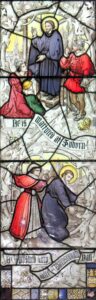
When he celebrated Mass in the North he would attract huge crowds and even decades after his death local people in Lancashire were still talking about his sermons on the Hail Mary, the Ten Lepers, the Last Judgement and the King who went off on a journey. The pursuivants were always on this trail and he narrowly escaped capture while staying with the Worthington family of Blainscough Hall, near Wigan, when an astute maid-servant, seeing the search party arrive, affected a squabble with the saint and pushed him into a duck pond, which effectively disguised him (pictured in stained glass above).
At Park Hall in Charnock Richard, Lancashire, St Edmund wrote his Rationes Decem – the Ten Reasons against the falsehood of Protestantism – and printed it at Stonor Park, near Henley, Oxfordshire, on his return to the South.
Soon afterwards was he taken at Lyford Grange, Berkshire, betrayed by George Eliot, a renegade Catholic who was being prosecuted for murder and who saw a chance to save himself.
St Edmund Campion endured four months of torture in the Tower of London. Fingernails were torn out and he was racked so severely that he was unable to raise a hand to take the oath at his trial in Westminster Hall. His torments were punctuated by theological debates with Puritans.
These were discontinued at the behest of the Anglican Bishop of London who saw him winning over the audience to the Catholic faith. Witnesses who converted included St Philip Howard.
Then came the show trial in Westminster Hall and it was a chance for England’s diamond to sparkle. St Edmund and 19 other priests were charged with treason under an Act of 1351 that did not pertain to religion.
The purpose was to send out the message that the priests were not condemned for their faith. St Edmund, speaking for the group, demolished the prosecution’s case as absurd (this is shown by the official record) but it was never going to save their lives. Finally, he gave his beautifully eloquent closing oration, which gives us a glimpse of his incisive, trenchant rhetorical genius.
“It was not our death that ever we feared,” he said. “We knew that we were not lords of our own lives, and therefore for want of answer would not be guilty of our own deaths. The only thing that we have now to say is, that if our religion do make us traitors, we are worthy to be condemned; but otherwise are and have been true subjects as ever the Queen had.
“In condemning us you condemn all your own ancestors – all that was once the glory of England, the island of saints, and the most devoted child of the See of Peter. For what have we taught, however you may qualify it with the odious name of treason, that they did not uniformly teach? To be condemned with these great lights – not of England only, but of the world – by their degenerate descendants, is both gladness and glory to us. God lives; posterity will live: their judgement is not so liable to corruption as that who are now going to sentence us to death.”
St Edmund Campion went to his death a man of conscience. On the scaffold at Tyburn he prayed for Elizabeth, who he again acknowledged to be his queen. His loyalty so moved Sir Charles Howard, a Protestant noble, that he ensured the saint was allowed to hang until dead before he was dismembered.
His execution was immediately followed by that of fellow priests St Ralph Sherwin, who kissed the executioner’s hand wet with St Edmund’s blood, and St Alexander Briant, both of whom had been condemned with him.
It was reported that on the day of their executions, December 1, 1581, the Thames stopped flowing, standing still as a supernatural sign of God’s indignation. It will never be known whether this is true. But, certainly, the one thing that was able to stand as a result of the witness of St Edmund Campion and his fellow martyrs, however, was the Catholic Church in England and Wales.