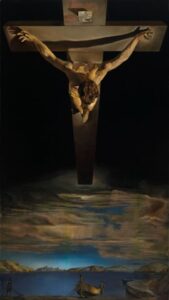
St John of the Cross was a 16th century Spanish mystic, theologian and poet and is honoured as one of the Doctors of the Church. Besides one of his sketches being the inspiration for Salvador Dali’s masterpiece, Christ of St John of the Cross, the saint is probably best known for his spiritual classic, The Dark Night of the Soul.
The work was written when St John was rector of the college at Alcala shortly after he had joined the discalced Carmelites at the promptings of St Teresa of Avila. It describes how after tasting the first joys of life as a contemplative friar he entered a period of spiritual desolation, a dryness devoid of any sensible devotion. This was accompanied by an interior trouble of mind, scruples and a distaste for spiritual exercises. St John sensed Satan was assaulting him with violent temptations and he was also being persecuted by the calumnies of men. He endured an interior agony and temptations underpinned by the feeling that God had deserted him. But withstanding these trials, he emerged into the consolation of a powerful sense of divine love and new light.
John was the youngest of three children born to Gonzalo de Yepes and Catherine Alvarez in 1542 in Fontiveros, Old Castile. His mother died when he was about a year old and his father tried to raise his family amid dire poverty, but John was eventually sent to an orphanage. He unsuccessfully served as a weaver’s apprentice but by the age of 15 was performing the most menial and unpleasant tasks in a hospital for people with sexual diseases. His intelligence was noticed by the administrator who encouraged him to be a priest, saying he could return as hospital chaplain if he joined the Jesuits at Medina del Campo. He entered at the age of 18 and for the next four years studied social sciences, rhetoric and classical languages under the Society of Jesus but left with the conviction that he was called to monastic life. Among the many orders present in Medina at that time, St John felt his vocation was to be a monk of the Carmelite order.
He joined in 1563 and took the religious name of Matthew. He studied Philosophy and the arts for the next three years at the University of Salamanca and in 1567 he was ordained a priest. He went back to Medina del Campo to celebrate his first Mass in the presence of members of his family.
It was in Medina soon afterwards that St John met St Teresa of Jesus, or Avila, for the first time. She set out her plan for the reform of the male branch of the Carmelites and invited St John to participate in the project “for the greater glory of God”.
Both fascinated and persuaded by St Teresa’s ideas, he worked with her for months, mostly on plans to open the first house of Discalced Carmelites, which they did on 28th December 1568, in Duruelo, a backwater in the province of Avila.
St John, with three other companions, formed the first male community. They renewed their religious profession according to the Primitive Rule, and adopted new names: the saint then called himself “John of the Cross”.
At the end of 1572, St Teresa invited the friar to serve as spiritual director of her Convent of the Incarnation, near Avila, where she was prioress. Her reforms were by then being met, however, with ferocious opposition, chiefly from Observant Carmelites, and John was jailed first in Medina del Campo and then in Toledo, where he was kept in near darkness, half starved, badly beaten and interrogated. It was during this latter period that he wrote some of his finest poetry, including the famous Spiritual Canticle. Eventually, after nine months, he escaped and fled to Beas and soon afterwards became prior of a convent near Granada and deputy vicar general of the Discalced Carmelites in Spain. St John established new convents, taught and he continued to compose poems and write commentaries on them.
But with the death of St Teresa in 1582 he found himself deprived of the protection of one of his most powerful allies and closest friends. An internal dispute among the Discalced friars, on whether to separate from the order, revealed just how exposed he was when, after pleading the moderate position, he was reduced to the status of a simple friar and sent to the remote friary of Penuela, “thrown into a corner like an old kitchen cloth”. But even among the mountains, where he spent his days in meditation and prayer, he was hounded by his enemies, some of whom were seeking to discover scandal in an attempt to expel him from the order.
When he finally fell acutely ill he was moved to Ubeda. He suffered acutely there for three months before he died on 14th December 1591 while his brothers recited the Morning Office. The saint departed from them with the words: “Today I am going to sing the Office in Heaven.”
St John’s fellow friars had a full-length life-size portrait of him painted as soon as he expired. His body was then taken to Segovia. John was beatified in 1675 by Pope Clement X and canonised in 1726 by Pope Benedict XIII. In 1926 he was declared a Doctor of the Church by Pope Pius XI and is traditionally referred to as Doctor Mysticus, the “mystical Doctor”.
In a General Audience of 16 February 2011, Pope Benedict XVI discussed in detail why this saint has earned this title. He described St John as “one of the most important lyric poets of Spanish literature, and commented on what he described were the saint’s four most important works: Ascent of Mount Carmel, Dark Night of the Soul, Spiritual Canticle, and Living Flame of Love.
The Spiritual Canticle presents the path of purification of the soul, the Pope explained; that is, the progressive joyful possession of God until the soul feels that it loves God with the same love that it is loved by him.
The Living Flame of Love continues in this perspective, describing in greater detail the transforming union with God. Benedict said that the example used by John is always that of fire: as the fire burns and consumes the wood, it becomes incandescent flame, so also the Holy Spirit, who during the dark night purifies and “cleanses” the soul, then in time illumines and warms it as if it were a flame. The life of the soul is a continuous celebration of the Holy Spirit that enables one to perceive the glory of the union with God in eternity.
The third work, The Ascent of Mount Carmel, presents the spiritual itinerary from the point of view of the progressive purification of the soul, necessary to ascend to the summit of Christian perfection, symbolised by the summit of Mount Carmel.
Pope Benedict explained that “this purification is proposed as a journey that man undertakes, collaborating with divine action to free the soul from all attachment or affection contrary to the will of God. The purification, which to arrive at union of love with God must be total, begins with the way of the senses and continues with the one obtained through the three theological virtues – faith, hope and charity – the purification of intention, memory and will”.
On the other hand, The Dark Night describes the “passive” aspect, that is, God’s intervention in the process of “purification” of the soul. On its own, in fact, human effort is incapable of getting to the profound roots of the person’s bad inclinations and habits: it can restrain them, but not uproot them totally.
“To do so,” Pope Benedict continued, “the special action of God is necessary, which purifies the spirit radically and disposes it to the union of love with him. St John describes this purification as ‘passive’ precisely because, though accepted by the soul, it is realised by the mysterious action of the Holy Spirit who, as a flame of fire, consumes every impurity. In this state, the soul is subjected to all types of trials, as if it were in a dark night.”
Taken together, these works present a “vast and profound mystical doctrine”, all delineating a state of perfection which can take us to heaven.
St John understood, as the Catechism of the Catholic Church reminds us, that creatures and creation mirror the majesty of the One who created them, and can teach us some things about God. But he also understood, that faith “is the only source given to man to know God exactly as he is in himself, as God One and Triune”. To come to perfect love of God, therefore, every other love must be conformed in Christ to divine love.
“This is where John of the Cross derives his insistence on the need for purification and interior emptying in order to be transformed in God, which is the sole end of perfection,” Pope Benedict said in his commentary. “This ‘purification’ does not consist in the simple physical lack of things or of their use. What the pure and free soul does, instead, is to eliminate every disordered dependence on things. Everything must be placed in God as centre and end of life. The long and difficult process of purification exacts personal effort, but the true protagonist is God: all that man can do is to ‘dispose’ himself, to be open to the divine action and not place obstacles in its way.
“Living the theological virtues, man is elevated and gives value to his own effort. The rhythm of growth of faith, hope and charity goes in step with the work of purification and with progressive union with God until one is transformed in him. When one arrives at this end, the soul is submerged in the very Trinitarian life, such that St John affirms that the soul is able to love God with the same love with which he loves it, because he loves it in the Holy Spirit. This is why the Mystical Doctor holds that there is no true union of love with God if it does not culminate in the Trinitarian union. In this supreme state the holy soul knows everything in God and no longer has to go through creatures to come to him. The soul now feels inundated by divine love and is completely joyful in it.”
Benedict XVI finally put this question to his audience: “Does this saint with his lofty mysticism, with this arduous way to the summit of perfection, have something to say to us, to the ordinary Christian who lives in the circumstances of today’s life, or is he only an example, a model for a few chosen souls who can really undertake this way of purification, of mystical ascent?”
The answer, he proposed, was to be found in the saint’s works and it is somewhat surprising. The road may be arduous but the burden is light. Faith, a deepening love, and a willingness to let oneself be loved by God in Christ Jesus helps us to carry out daily burden and to face the challenges and toils of life with joy. They are a source of strength, the wisdom we need to truly discern and fulfil our vocations in life, and ultimately to attain the promise of salvation.
St John of the Cross, pray for us.