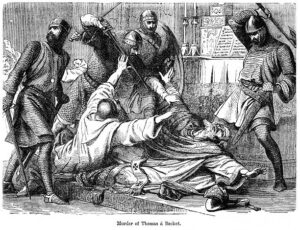
There are few events in the history of the English Catholic Church that have resonated down the centuries like the martyrdom of St Thomas Becket, the Archbishop of Canterbury, who was hacked to death in his own cathedral in 1170 by three knights who had taken literally a throwaway remark of King Henry II, wishing to be rid of “this turbulent priest”.
St Thomas was born in 1118 off Cheapside, London, to Gilbert, the Sheriff of London, and Matilda. At the age of 24 he obtained a minor post in the household of Theobald, Archbishop of Canterbury, and went on to receive minor orders before he was nominated as archdeacon of Canterbury.
Even then he lived a largely worldly life, dressing “more like a falconer than a cleric”, and on one occasion he led 700 of his own knights into battle with the French. He became a good friend of King Henry who made him Chancellor at the age of just 36 and when Theobald died in 1161 the King nominated St Thomas as the archbishop’s successor.
Soon afterwards, St Thomas was ordained priest and subsequently the archbishop in 1162. He received the pallium from Pope Alexander III and he began to radically amend his way of life, donning a hair shirt and clerical garb, and rising early each day to read the Scriptures and to celebrate Mass, and to distribute alms to the poor.
St Thomas had prophetically warned the King that his elevation to Canterbury would bring the friends into conflict. “For several things you do in prejudice of the rights of the Church make me fear you would require of me what I could not agree to,” he told the monarch, “and envious persons would not fail to make this the occasion of endless strife between us.”
The encroaching power of the Crown over the bona fide rights of the Church soon saw clashes between the King and the Archbishop on such matters as the supremacy of the civil law over trials of clergy in ecclesiastical courts and over systems for extracting the maximum revenue from Church property.
The deterioration of relations reached a crisis point when Henry demanded that the bishops assented to the 16 Constitutions of Clarendon, a one-sided pronouncement by the Crown on disputes between Church and State. St Thomas rejected the provisions with the words: “By Almighty God no seal of mine shall be put on them.” In 1164 St Thomas then went into exile in France, residing mostly at the Cistercian abbey of Pontigny and the Abbey of St Columba, Sens, for some six years while his appeal to the Pope was negotiated with the King. In July 1170, Henry and St Thomas met in Normandy and were reconciled but without referring to the dispute that had so starkly and bitterly divided them.
In his absence the Archbishop of York crowned Henry’s son, to ensure succession, usurping a privilege of his counterpart in Canterbury and, according to Butler’s Lives of the Saints, also probably in defiance of the instructions of the Pope. Shortly after returning to England on December 1st St Thomas dealt robustly with the problem by excommunicating the Archbishop of York and the bishops of London and Salisbury, who had assisted him at the coronation, and suspending other bishops who had attended. He also denounced them from the pulpit of Canterbury Cathedral.
The three excommunicated bishops were so aggrieved by their censures that they travelled to France to complain about St Thomas directly to King Henry, who was in Normandy. It was there that the King flew into a rage and made his utterance that led, against his true wishes, to the murder of Thomas. “Who will rid me of this turbulent priest?” he said.
The four knights who then set off for England in response to this challenge were Reginald Fitzurse, William de Tracy, Hugh de Morville and Richard le Breton. They arrived in Canterbury on the afternoon of December 29 and demanded that St Thomas removed the censures from the three bishops. The meeting broke up with the knights making threats against the saint. They returned soon afterwards, breaking down doors and screaming for “the traitor”.
The knights, joined by a sub-deacon called Hugh de Horsea, caught up with St Thomas between the altars of Our Lady and St Benedict in Canterbury Cathedral. The saint was seized by Fizurse, who was brandishing an axe and thrown against a wall. After a brief exchange of words, de Tracy struck the first blow, grazing the saint. Another blow beat the archbishop to his knees and then he uttered his last words: “For the name of Jesus and in defence of the Church I am willing to die.”
St Thomas pitched forward on to his face and Le Breton severed his scalp with a tremendous blow which broke his sword on the stone floor. De Horsea scattered the saint’s brain over the stones with the point of his sword. Of the four knights, De Morville alone did not participate in the frenzy.
The murder of the metropolitan in his own cathedral scandalised Europe. Henry undertook public penance in 1174 after the solemn canonisation of St Thomas as a martyr by Pope Alexander at Segni.
In 1220 the body of St Thomas was translated from its tomb in the crypt to a shrine behind the high altar and was one of the six most popular pilgrimage destinations of the Medieval period. The shrine was destroyed by King Henry VIII in 1538 but some of the saint’s relics were smuggled out of the country to Italy.
St Thomas’s feast is kept throughout the Western Church and in England he is additionally venerated as the protector of secular clergy.
St Thomas Becket, pray for us.