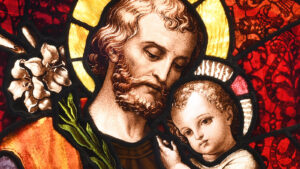
St Joseph, the husband of Our Lady and the foster father of the child Jesus, is described in the Sacred Scripture as being a “righteous” man. But the Church’s knowledge of him is restricted solely to the Gospel accounts of St Matthew and St Luke concerning the birth and early life of Our Lord that are familiar even to young Christian children.
The Evangelists tell us that he was of royal descent and that he was betrothed to the Blessed Virgin Mary. Saddened by her pregnancy, he seeks a quiet separation until he is enlightened by an angelic vision that the child has been conceived by the Holy Spirit.
St Joseph then becomes an intimate part of the Christmas story. The heavily pregnant Virgin Mary left Nazareth in Galilee with him to travel to Bethlehem, the birthplace of his ancestor, King David, so he can be registered for a census being taken throughout the Roman Empire.
St Joseph and Mary were together as they tried without success to find a room for the night and he was with her when she gave birth to Our Lord in a stable. According to St Matthew, it was St Joseph who named the baby Jesus.
The saint also witnessed the homage paid to the child by the shepherds and later by the three wise men. It was to St Joseph that an angel appeared in a dream, urging him to take the Holy Family to Egypt to escape Herod and it was revealed to him, also in a dream, the time when it was safe to return to Israel.
St Joseph was also present when Our Lord was placed in arms of Simeon at the Presentation in the Temple. He shared the sorrow of his wife when the boy Jesus was lost in Jerusalem and her joy when he was found debating with the doctors.
St Joseph emerges throughout as the protector and provider of the child Jesus. He would have been partly responsible for his education and it was his trade – carpentry – in which Our Lord was trained.
He was also the protector of Our Lady’s good name, Butler’s Lives of the Saints reminds us, and the confidant of Heaven’s secrets. He is often depicted in art holding a lily to symbolise purity, following from St Matthew’s comment that he did not have conjugal relations with the Blessed Virgin.
It is likely, too, that St Joseph was a number of years older than Mary, and that it is probable that she was a teenager at the time she conceived Our Lord. The fact that St Joseph is not present during Jesus’s adult life is just one indication that he had by then died. According to Roman Martyrology his heavenly birthday is March 19.
Devotion to St Joseph has always been strong and popular. It was promoted particularly by the orders of the Counter Reformation and such veneration is continuing to the present day, with the Church adding the name of St Joseph to the first Eucharistic prayer of the Roman Canon as recently as 1962.
In 1870, at the close of the First Vatican Council, Pope Pius IX proclaimed St Joseph to be the patron of the Universal Church. He is also the patron of working men (with the Feast of St Joseph the Worker, instituted in 1956, celebrated on May 1), of fathers of families – and of a “holy death”, because it was assumed that he died in the presence of Jesus and Our Lady.