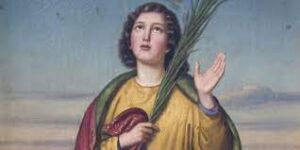
St Pancras was boy of 14 years of age when he was beheaded for his faith in 304 under the persecution of the Emperor Diocletian, the last, largest and bloodiest official persecution of Christians in the history of the Roman Empire.
Like many of the Roman martyrs, details of the life of St Pancras are few and his “acts” bear anachronisms that cast doubt on the veracity of every point.
It has been traditionally taught, however, that St Pancras was born to Roman parents in either Syria or Phrygia, present-day Turkey, but was brought to Rome by an uncle after he was orphaned. There, both of them converted to Christianity, with Pancras suffering death on the Via Aurelia in the second year of the eight-year Diocletian persecution.
He was, according to Butler’s Lives of the Saints, then buried in the cemetery of Calepodius, which was later named after him, and around the year 500 a basilica was built or rebuilt over his tomb by Pope Symmachus.
A cult in honour of the martyr certainly seems to have been in existence at around this time and in the centuries that followed the basilica built in his honour was restored, and Pope St Gregory the Great built a Benedictine monastery under his invocation.
St Augustine of Canterbury, the Benedictine monk and “Apostle to the English” dispatched to Britain by St Gregory, dedicated the first church he built upon arriving in Kent to St Pancras. Fifty years later Pope St Vitalian made a gift of some relics of the martyr to Oswy, the King of Northumberland, an act which helped to propagate the cult to St Pancras in England.
One of the oldest churches in London is named after St Pancras and it gives his name to the area now famous for its railway station. Previously, its churchyard had become renowned as the final resting place for recusant Catholics during the penal times.
In Spain there still exists today a strong popular devotion to the teenage martyr and he is often invoked for matters involving health and jobs.
St Pancras has also often been invoked against false witness and perjury, with St Gregory of Tours describing the saint as the “avenger of perjuries” following the legend that God visibly punished false oaths taken near his relics.