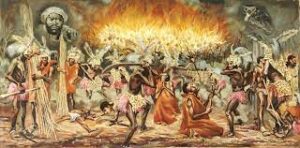
St Charles Lwanga and companions are venerated as the proto-martyrs of sub-Saharan Africa. They suffered terrible persecution under the rule of Mwanga II, a kabaka (king) both threatened by the spread of Christianity and infuriated by the refusal of Christian adolescent boys to indulge in his vices.
The first Catholic missions in the African interior were established in 1879 by the White Fathers. Progress was made in Uganda under the Mtesa, the local ruler, and the first Catholic missionaries set up a base in Baganda. The mission flourished until 1884 when he died and was succeeded by Mwanga, his 18-year-old son.
The illiterate ruler felt threatened by the education of children by the missionaries and he was also being counselled by witch doctors and fetishists opposed to the spread of Christianity and its apparent foreign influences. He was also drinking heavily, smoking hemp and given strongly to homosexual practices, which some historians say he learned from white traders.
His persecution of the Church was preceded by the murder of James Hannington, the Anglican Bishop of Eastern Equatorial Africa, who made the mistake of trying to make his way to Baganda across Masai territory closed to white people.
At the same time Mwanga was making sexual advances to young pages in his court, some of whom had converted to Christianity and who resisted him.
These boys were defended by St Joseph Mkasa, a Catholic convert and catechist, who also denounced Mwanga for the massacre of Hannington and his caravan. He was beheaded on 15 November 1885, the first martyr to suffer, and was succeeded as master of the pages by St Charles, another Catholic.
Mwanga was horrified to discover that the martyrdom of St Joseph had the effect of galvanising the faith of the African Christians. When he discovered a page called Mwafu had been receiving instruction from St Denis Ssebuggwawo Wasswa, another page, he sent for St Dennis and personally thrust a spear through the 16-year-old’s throat before ordering him to be hacked to pieces. The same night guards were posted around the royal residence to prevent anyone from escaping.
With persecution imminent, St Charles secretly baptised four pages, including St Kizito, a boy of 13 who he had repeatedly saved from the designs of the king.
The next morning the pages were summoned before Mwanga and the Christians were ordered to separate themselves. Led by St Charles and St Kizito – the oldest and the youngest – they totalled 15 males under the age of 25 years. They were joined by two others already under arrest and by two soldiers. Mwanga asked them if they wished to remain Christian. “Till death!” came the response. “Then put them to death,” Mwanga answered.
The convoy set out to the place of execution, Namugongo, some 37 miles away. Three of the party were killed en route and the remainder were held at Namugongo for seven days while a huge pyre was built.
Then on Ascension Day, 3 June 1886, they were brought out, stripped of their clothing and bound, then each tied to a mat of reed and laid on the pyre which was set alight. One boy, St Mbaga, was first killed by a blow to his neck on the orders of his father, the chief executioner.
The persecution lasted another two years, ending only on the death of Mwanga in 1888. As it spread, as many as 24 Anglicans died as well as Catholics.
A leader among the confessors was St Matthias Murumba Kalemba, a 50-year-old assistant judge who first heard about Jesus Christ from Protestant missionaries from the London-based Church Missionary Society before he was received into the Catholic faith by the White Fathers. He was tortured to death with astonishing cruelty in an ordeal that last three days.
Another martyr was St Andrew Kaggwa, chief of Kigowa, who had converted to the Catholic faith with his wife and who had gathered a large body of catechumens around him. He was beheaded.
The persecution resulted in a great number of converts to Christianity and by 1890 there were 10,000 Christians in Baganda. Catholic and Anglican shrines were built at Namugongo and they continue to draw crowds of pilgrims to this day. The Catholic shrine is in the shape of a pyre and it has the story of the martyrs carved on its bronze doors.
St Charles, St Kizito, St Andrew, St Matthias, St Denis, St Mbaga and St Joseph were among 22 Catholic martyrs – 17 of whom were young royal servants – to be solemnly beatified in 1920. They were all finally canonised by Pope St Paul VI on 8 October 1964, the Mission Sunday that preceded the opening of the third session of the Second Vatican Council. Five years later, when Pope Paul became the first Pontiff ever to visit Africa, he made a pilgrimage to Namugongo.