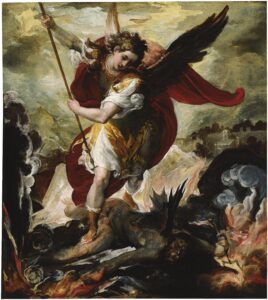
St Michael is one of three archangels honoured by the Catholic Church on this day, the other two being St Gabriel and St Raphael.
The cult of the three archangels began in the East before spreading to the West where their feast day coincides with the celebration of the dedication of the 5th century Basilica of St Michael on the Salarian Way in Rome, a date which later became known commonly as Michaelmas Day.
St Michael appears in both the Old and the New Testament. In the former he is presented as the protector of Israel. He is referred to as “one of the Chief Princes” in the Book of Daniel and the Prophet Daniel is told that in the persecution at the end of time “Michael will arise – the great Prince, defender of your people”.
In the New Testament, St Michael is described specifically as an “archangel” in the Letter of St Jude when the Apostle alludes to the contest between the him and the Devil over the body of Moses, which, according to Jewish folklore, Satan had tried to claim because Moses had killed the Egyptian.
More explicitly, Chapter 12 of the Book of Revelation depicts St Michael leading the armies of God in the battle against the dragon, in which Satan and his cohorts are hurled to the earth from Heaven.
As an angel, St Michael is a non-corporeal being, a spiritual creature of intelligence and will, “surpassing in perfection all visible creatures”. The title of “archangel” refers to his office, as the leader of angels and a servant of God.
Christian tradition and Scripture hold that the major responsibilities associated with the office of St Michael are to combat Satan, to escort the faithful to heaven in the hour of their deaths, to act as a champion God’s people, and to call people from earth to their heavenly judgement.
In the Eastern Orthodox Church, St Michael is given the additional title of “Archistrategos”, or “Supreme Commander of the Heavenly Hosts”.
In 1886, Pope Leo XIII composed the Prayer to St Michael and ordered it to be recited at the end of every Mass: It reads:
Saint Michael Archangel,
defend us in battle,
be our protection against the wickedness and snares of the devil;
may God rebuke him, we humbly pray;
and do thou, O Prince of the heavenly host,
by the power of God, cast into hell
Satan and all the evil spirits
who prowl through the world seeking the ruin of souls.
Amen.
The obligation was removed in 1964 but in a Regina Caeli address of 1994 Pope St John Paul II publicly recommended that Catholics should continue to recite the prayer “to obtain help in the battle against the forces of darkness and against the spirit of this world”. Pope Francis has also asked Catholics to recite the prayer regularly.
The intercession of St Michael is also invoked by the Church in formal prayers and rites of exorcism.
In art, St Michael is often depicted in armour treading on a dragon or the Devil and bearing a sword or spear and sometimes holding scales.
He is considered the Guardian of the Catholic Church and of Vatican City is also revered as patron of police officers, soldiers, grocers, mariners, paratroopers, firefighters, paramedics, and the sick.