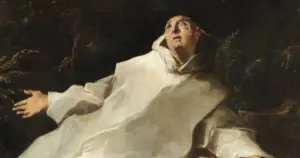
St Bruno founded the Carthusians, a strict order of monks and arguably the only one in the Church which has never been reformed.
He was born in 1032 in Cologne, Germany, into one of the most eminent Catholic families of the city. He studied at Rheims and Tours in France where he was admired for his academic brilliance before returning to Cologne to study theology and he was ordained priest in the city of his birth in 1055. At the age of just 27 years Bruno was appointed as rector of the cathedral school in Rheims.
He served there for 18 years and his reputation as a distinguished tutor spread throughout Europe. One of his pupils during that time was Eudes de Chatillon, the future Pope Urban II.
St Bruno later became the chancellor of the Archdiocese of Rheims and he came into conflict with the archbishop, who, according to Butler’s Lives of the Saints, “had obtained the post by simony and lived a life of scandal wealth”.
The saint, along with other priests of the diocese opposed him and appealed to the Pope. The archbishop reacted by persecuting his opponents who took refuge in the castle of Ebles de Roucy. Bruno finally returned to Cologne when Gregory VII decided that the archbishop should remain in his see.
St Bruno was by no means disgraced by this episode and he was about to be appointed as the new Archbishop of Rheims when he felt called by God into a life of exemplary poverty, austerity and solitude. He gave up all of his possessions and positions and with a few friends went to Molesme, the first Cistercian foundation.
After a while he decided that his present home was unsuitable and asked St Hugh, the Bishop of Grenoble, for permission to establish a community in a wooded and mountainous part of the diocese. The bishop gave the monks a remote valley known as La Chartreuse, where they built an oratory and lived a life partly hermitical and partly as community. They lived in cells and met only to pray matins and vespers and for Mass on Sundays and feast days. The monks divided the rest of their time into periods of reading, study and manual work, such as copying manuscripts. They wore hair shirts and would not eat meat, and would eat fish only when it was given to them as alms.
But after six years, the saint’s former pupil, now Pope Urban, summoned him to Rome to serve as a counsellor, principally to help with the reform of the clergy and in a quarrel with Gilbert of Ravenna, an antipope. The departure of St Bruno was a “cause of inexpressible grief” to his followers, some of whom left the community afterwards or who attempted to join him in Rome where Bruno had established a hermitage among the ruins of the baths of Diocletian.
Soon, Pope Urban began pressing the saint to accept the archbishopric of Reggio in Calabria, Italy, but this was declined. Instead, St Bruno persuaded the Pope to allow him to retreat into the wilderness of Calabria and found a new monastic settlement there. His wish was granted and he founded a second monastery at La Torre, modelled on Chartreuse, and five years later another, St Stephen’s, to meet the demand from men wishing to enter the community.
St Bruno kept in touch with his fellow monks by letter. But he had not intended to establish a religious order so left no rule. The inspiration for the Carthusians is derived from the way of life the saint advocated in his letters and from his final testament that he left to his monks just before his death at La Torre on October 6, 1101.
The saint was buried at St Stephen’s and his body was found to be incorrupt when it was dug up for transfer back to La Torre in 1513. He was canonised “equivalently” when his feast day, which Pope Leo X had permitted the Carthusians to keep in 1514, was extended to the universal Church in 1674 by Pope Clement X.
The Carthusians first arrived in England in 1173 and they established nine houses in the following 350 years.
Three Carthusian priors – Ss John Houghton, Augustine Webster and Robert Lawrence – became the first martyrs of the Protestant Reformation in England when they were executed by King Henry VIII at Tyburn, London, on May 4, 1535, for high treason after they refused to take an oath attached to the Act of Succession.