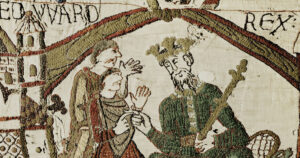
St Edward the Confessor was one of the last of the Anglo-Saxon kings and was formerly a patron saint of England until King Edward III supplanted him with St George. He founded Westminster Abbey in place of making a pilgrimage to Rome and he is entombed there. The abbey, dedicated to St Peter, stood west of the city of London and gave its name to an area that is now the seat of the British government – in contrast to St Paul’s Cathedral, the minster in the east. Today St Edward is venerated as a patron saint of the Archdiocese of Westminster and the bell at Westminster Cathedral was named “Edward” in his honour.
Commonly known as the “Confessor” – to differentiate him from St Edward the Martyr, a 10th century Anglo-Saxon king – Edward was regarded as a saint even in his own lifetime because of his piety and his generosity and attentiveness to the poor and to the Church.
The Confessor was the son of King Ethelred the Unready. He was born in 1005 and educated at Ely, Cambridgeshire, before he moved to Normandy at the age of 10 for his own safety at a time when England was suffering a period of internal turmoil and upheaval.
He was accompanied by his brother, Alfred, who was mutilated and then killed at the hands of Earl Godwin of Wessex when he attempted to return to England in 1036.
The situation was so dangerous that Edward did not return for more than 20 years and came back only when Harold “Harefoot” chose him as his successor in 1041. Edward became king the following year and, according to Butler’s Lives of the Saints, ruled with patience, caution and pragmatism, strengthening the army and navy and defending the Crown against the designs of such over-ambitious nobles as Godwin.
Two years after ascending to the throne, Edward married Edith, the daughter of Godwin, possibly in an attempt to bring unity to his kingdom. But in 1051 the earl again threatened rebellion, so the king banished the family overseas and sent Edith – his own queen – to a convent for a time.
That same year saw a visit to the English court by William of Normandy – the Conqueror – and it is extremely likely that St Edward offered him the succession to the throne. Eventually, Edward permitted Earl Godwin to return from exile and there followed a backlash against rising Norman influence, with Frenchmen outlawed from the country, including the Norman Archbishop of Canterbury and another bishop who fled overseas.
Amid the uncertainty, there can be no doubting the Confessor’s generosity to the poor and his commitment to the Church: as king he won the hearts of his people, always apparently ready to listen to their grievances.
His favourite pastimes were hunting and hawking, which he would pursue for days on end, but he always attended Mass first thing in the morning.
The origins of Westminster Abbey stem from a promise made to God by Edward, during his time in exile, to make a pilgrimage to the tomb of St Peter in Rome if the tribulations of his family were mitigated. When he became king, he told the English court of his obligation and, given the impossibility of him leaving his kingdom, the matter was referred to Pope Leo IX, who dispensed with his vow on the conditions that he gave what would have been the cost of the pilgrimage to the poor and that he restored or built a monastery in honour of St Peter.
The last year of the Confessor’s reign were dogged by troubles with the Northumbrians and their earl, Tostig Godwinsson, whom the king was eventually forced to banish. At the end of the year – 1065 – Westminster Abbey was consecrated with great solemnity but St Edward was too ill to attend. He died a week later.
His relics survived the Reformation as Henry VIII was reluctant to desecrate the grave of a king. They remain in Westminster Abbey, and his feast of October 13 is the only day of the year when visitors can enter for free.