St Martin of Tours was a fourth century Roman soldier who resigned his post after a dream in which he saw Our Lord in the guise of a beggar and went on to establish monasticism in the West and to become Bishop of Tours, France.
Born in 336 in Pannonia, a Roman province covering the western part of present-day Hungary, St Martin had been forced to follow his father’s profession of soldier, even though at about this time he felt drawn to Christianity and might have objected to fighting.
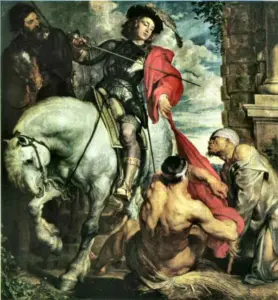
He was posted to Amiens in northern France where on a cold winter day he took pity on a beggar he saw shivering with cold outside the gates of the city, slicing his own cloak in two and giving half of it to the stranger to keep himself warm.
That night he saw Jesus Christ in a dream wearing the half-cloak and saying: “Martin, still a catechumen, has covered me with his garment.”
St Martin immediately sought baptism and he also asked to leave the Roman army since, as “soldier of Christ” it was no longer legitimate for him to fight for the empire. As a member of the Imperial Guard he was not allowed to resign so he was briefly imprisoned on a charge of cowardice before he was released and placed into the hands of St Hilary of Poitiers who ordained him to the minor order of exorcist as popular opposition to former soldiers becoming clerics prevented his ordination as a deacon.
He crossed the Alps to return to his homeland, narrowly escaping robbers, and encouraged his family to become Christians (his father resisted). On his return to Italy he discovered that the Arian ascendancy in Gaul has resulted in the exile of St Hilary.
On hearing this Martin, who had been scourged for preaching against Arianism on the Dalmatian coast, decided to stay in Milan. But the bishop, Auxentius, an Arian, forced him to retire to an island in the Gulf of Genoa. He rejoined St Hilary in 360 when the bishop was allowed to return to Poitiers.
St Martin by then had discerned a vocation to a solitary life. St Hilary gave him some land and others, inspired by his example, joined him and Butler’s Lives of the Saints states that what is “generally considered the first monastic community in Gaul came into being”.
St Martin lived, taught and preached there for 10 years until the people of Tours demanded that he became their bishop.
He initially resisted this office but accepted after he was lured into Tours with a story that a sick man had requested a visit from him. As bishop he continued to live a simple monastic life, first from a cell near to his cathedral and then outside the city at Marmoutier, where he founded an abbey which soon grew into a large community and a centre for evangelisation.
Christianity was an urban religion in Gaul and St Martin is credited with spreading the faith through the rural areas, travelling around his diocese on foot, by donkey or by boat to preach and extend pastoral care into the countryside.
He was opposed to the persecution of heretics but became embroiled in a doctrinal dispute with the Priscillianists, some of whom were eventually executed following a complex series of events involving the bishops and the secular powers, an event which caused him anguish for the rest of his life.
St Martin fell ill and died in a remote part of his diocese on 8 November 397 and was buried in Tours three days later, on what became his feast day.
His life was recorded by Sulpicius Severus, who visited him frequently in his final four years. The work was novel because it celebrated the life of the saint rather than simply the way that he died. It helped to spread the cult of St Martin and as a result Tours became one of the most popular pilgrimage destinations in Europe until the religious wars of the 16th century.
St Martin’s encounter with the beggar at Amiens also became a popular subject in art.