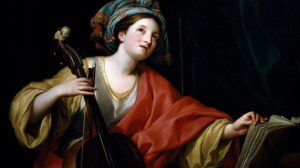
St Cecilia was a Roman virgin who was martyred for her faith and who is today venerated as the patron saint of music and musicians, since her Acts record that she sang to the Lord “in her heart” on her wedding day. In the Middle Ages she was often represented as playing the organ and singing aloud.
Popular legend holds that she was a patrician girl who was raised a Christian. She did not consummate her marriage to Valerian, according to the legend, but instead converted him to her faith and showed him an apparition of an angel who placed on the heads of each of them a chaplet of roses and lilies.
The legend also holds that Valerian and his brother, Tiburtius, were brought before the Roma prefect, Almachius, after they were caught burying the bodies of martyred Christians. They were beheaded with a third man, an official called Maximus, after they refused to honour the pagan gods of the Romans.
St Cecilia buried their bodies and was then called upon to repudiate her faith too, but resisted and won more converts to the faith. According to the Acts, Pope Urban visited her home where he baptised 400 people, one of whom, a wealthy man named Gordian, later established a church in her house.
The saint was sentenced to death by suffocation but survived the attempt. A soldier was sent to behead her instead but abandoned her after slashing her neck three times. She died from her injuries three days later surrounded by Christians who flocked to her side, and after she gave Urban her house and committed her household to his care. St Cecilia was said to have been buried in the Catacomb of St Callistus.
The account of St Cecilia’s life and death dates back to about the 5th century but according to Butler’s Lives of the Saints it “can by no means be regarded as trustworthy or even founded upon authentic materials” because apart from references to a church founded in Trastevere by a lady named Cecilia there is no mention of her in the major writings from the period such as the poems of Damasus or Prudentius or the works of Ss Ambrose or Jerome.
It has been discovered, however, that Valerian, Tiburtius and Maximus were indeed martyrs, with their remains buried and identified in the Catacombs of Praetextatus.
A cult to St Cecilia has also survived down the centuries and is reflected in the arts. She is the subject of the second Nun’s Tale in Chaucer’s Canterbury Tales, for instance, and she was made the patron saint of music and musicians when the Academia della Musica was founded in Rome in 1584.
Such poets as Dryden, Pope and Auden have composed odes and hymns in her honour with Auden’s hymn set to music by Benjamin Britten. Handel also composed in her honour. The saint also appears in paintings by Raphael, Fra Angelico and Pietro da Cortona and numerous churches have been dedicated to her.