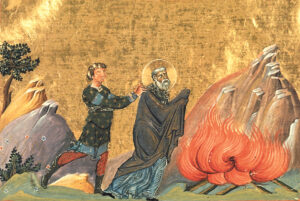
St Polycarp was a Bishop of Smyrna, a city in modern-day Turkey, and he was martyred by the local pagan people there in about the year 155.
Along with Clement of Rome and Ignatius of Antioch, St Polycarp is one of the three main Apostolic Fathers, those saints who personally knew one or more of the 12 Apostles.
St Polycarp was a disciple of St John, according to Tertullian and St Irenaeus of Lyons, who had heard him speak in his youth. “I remember how he spoke of his intercourse with John and with others who had seen the Lord,” St Irenaeus wrote, “how he repeated their words from memory, and how the things that he had heard them say about the Lord … were proclaimed by Polycarp in complete harmony with Scripture.”
St Jerome also expressed the belief that the Evangelist had ordained St Polycarp as Bishop of Smyrna.
St Polycarp was born in about the year 69. Not much is known about his life or his teachings but for the contents of two important documents.
One is a pastoral letter in which he quotes from the First Letter of St John and which was still being read in churches in Asia the fourth century. It defends the integrity of Sacred Scripture by attacking a figure called Marcion for refusing to accept the God of the Old Testament as the Father of Jesus Christ.
The other document is the Martyrium Polycarpi, the description of the saint’s martyrdom that was written by his congregation.
It recounts how the saint awaited his arrest at a farm, how he invited his captors to a supper, how he was paraded into Smyrna on a donkey, and questioned by Herod, the chief of police, before the crowd called out for a lion to be set upon him.
Instead, he was sentenced to be burned but was killed by a sword thrust into his neck when the flames apparently failed to hurt him.
His body was then cast on to a fire to prevent his followers having “communion with his holy flesh”, leaving Christians to forage only for bones as relics.
The death of St Polycarp is said to have established within the Church the essential elements of the cult of martyrs, who for several centuries were only those recognised as saints. These included the communal observance of the date of their deaths as their dies natalis, “birthday into heaven”, and the veneration of their relics.
Moreover, Butler’s Lives of the Saints asserts that the account of St Polycarp’s martyrdom “established the connection between devotion to the martyrs and the imitation of Christ”.
Pope Benedict XVI expounded a similar theme in Sacramentum Caritatis, his 2007 post-synodal exhortation on the Eucharist, in which he directly referred to the martyrdom of the saint.
“I would like to reflect on a notion dear to the early Christians, which also speaks eloquently to us today: namely, witness even to the offering of one’s own life, to the point of martyrdom,” the Pope Emeritus wrote. “Throughout the history of the Church, this has always been seen as the culmination of the new spiritual worship: ‘Offer your bodies’ (Rom 12:1). One thinks, for example, of the account of the martyrdom of Saint Polycarp of Smyrna, a disciple of Saint John: the entire drama is described as a liturgy, with the martyr himself becoming Eucharist … The Christian who offers his life in martyrdom enters into full communion with the Pasch of Jesus Christ and thus becomes Eucharist with him.”
He continued: “Today too, the Church does not lack martyrs who offer the supreme witness to God’s love. Even if the test of martyrdom is not asked of us, we know that worship pleasing to God demands that we should be inwardly prepared for it.”