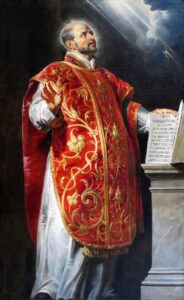
St Ignatius of Loyola was the Basque nobleman who during the middle of the 16th century founded the Society of Jesus – the Jesuits – the order at the spearhead of the Catholic or Counter Reformation, and one which helped to take the faith to China, India and the Americas, and to keep it alive in Britain during 150 years of persecution. It is an order which has always attracted immensely talented, learned and capable men, perhaps a reflection of the character and charism of the founder himself.
St Ignatius was born in about the year 1491 in the castle of Loyola at Azpeita in Guipuzcoa, a part of Biscay that stretches up the Pyrenees. He was the youngest of three daughters and eight sons and his parents came from distinguished families in the region: his father, Don Beltran, was lord of Onaz and Loyola and, as Butler’s Lives of the Saints tells us, his mother, Marina Saenz de Licona y Balda, was “no less illustrious”.
St Ignatius left home at the young age of 15 years to serve as a page in the household of Juan Velazquez de Cuellar, a treasurer to the King of Castile who lived at Arevalo, between Avila and Valladolid. He received a courtly education but was also indulged passions for gambling, women and duelling. In 1515 he was even brought to court for taking part in a premeditated ambush of some clergy.
His patron lost his position and retired heavily in debt on the death of King Ferdinand and the accession of his brother, Charles of Burgundy, so Ignatius went north to Pamplona and served for five years in the army of his relative, the Viceroy of Navarre. His military career came to an end when on May 20, 1521, a French cannonball broke through his right shine and tore up his left calf during the siege of Pamplona.
The triumphant French returned Ignatius to the castle of Loyola in a litter. His broken leg was badly set and it needed to be re-broken, and, a brave military man, he endured the pain without complaint.
But he struggled to amuse himself during his convalescence. He liked to read “romances” to pass the time but while recuperating he was given books about the life of Our Lord and of the saints. It was his experience of reading them that he first began to experience discernment of spirits. One text edified and consoled, he found, while the other brought spiritual desolation after some initial and transient gratification.
He soon began relishing holy texts and underwent a radical interior conversion to the faith. In his fervour he decided that once he had fully recovered he would make a pilgrimage to the Holy Land and also contemplated becoming a Cistercian lay brother. But a battle was raging within his soul, and he would sometimes be tempted by his flesh or for desire for glory, only to later experience heaviness of heart or bitterness. He would soon be practising rigorous self-mortification and weeping for his sins.
This came to an end when one night St Ignatius experienced a vision of Our Lady holding the Child Jesus in her arms. His soul was filled with delight and, cured of his physical infirmity, he left for Jerusalem only to find himself drawn to visit the Marian shrine at Montserrat, near Barcelona. It was at the altar of the Blessed Virgin Mary that the saint hung up his sword and dagger and dedicated his life to God after a night of deep prayer.
St Ignatius then became a hermit at the nearby town of Manresa, where he lived in cave for 10 months, constantly in prayer, study, fasting and penance. It was an experience initially marked by joy, peace of mind and heavenly consolation then conversely by great fears, doubts and spiritual dryness. Sometimes he felt on the brink of despair. But during this period of trial he began to record his experiences in what would become his Spiritual Exercises, one of the most famous books on spiritual life ever written. He once remarked that he was able to learn more in one hour at Manresa than all the doctors of the schools could ever have taught him.
In February 1523, St Ignatius again set off for the Holy Land, begging along the way. He spent Easter in Rome then sailed from Venice to Cyprus and on to Jaffa. He arrived in Jerusalem on a donkey and took great delight in visiting the holy places associated with the life of Our Lord. His zeal left the Franciscan guardians of these sites a little unnerved and they urged him to return to Europe before he put himself in danger by attempting to convert Muslims to Christianity.
He arrived back in Spain in 1524 and avidly applied himself to studies “as a means of helping him to work for souls”. He was 33 years old by then and learned to bear taunts from younger students as he studied Latin grammar in Barcelona for the following two years. He moved on to the University of Alcala where, begging for a living and wearing a coarse grey habit, he attended lectures in logic, physics and divinity. He also catechised children, held assemblies of devotion among the poor, and admonished sinners. A group of disciples gathered around him and his activities attracted the attention of the Inquisition and he spent 42 days in jail before he was finally deemed to be innocent, though warned not to ape religious orders.
He and three followers uprooted for Salamanca where again they were arrested. Three weeks in jail persuaded St Ignatius to leave Spain for Paris and he arrived there in 1528 and began to study philosophy. Six years later he graduated as a master of arts, at the age of 43.
Two years before his graduation, a group six students of divinity had associated themselves fervently with the saint in his spiritual exercises. They included the great missionary St Francis Xavier and St Peter Favre, a man canonised in 2013 by Pope Francis, the first Jesuit pope.
Ignatius was organising them to contribute to the reform of the Church and to perform acts of charity among the sick and the poor. On the Feast of the Assumption in 1534, together they adopted the evangelical counsels of poverty and chastity. They sought to preach the Gospel in the Holy Land but resolved to offer their services to the pope if they were not able to do so. These vows were made in a chapel in Montmartre and it was a moment often considered to be the inception of the Society of Jesus. Each of them afterwards received Holy Communion from St Peter Favre, who had been lately ordained a priest.
In 1536 the now 10-strong “Company of Jesus”, as they called themselves, met in Venice with a view to taking a ship to Palestine but hostilities between the Turks and the Venetians made it impossible. Instead they agreed to meet in Rome and it was while travelling there that St Ignatius had a vision of Our Lord as he prayed at a small chapel at La Storta. The vision was of Jesus shining with unspeakable light but burdened with a heavy cross. Our Lord said to Ignatius: “Ego vobis Romae propitious ero,” which means, “I will be favourable to you in Rome”.
With the encouragement of this divine confirmation, the group offered their services to Pope Paul III and proved the fervour of their charity during a period of famine in Rome. They also began to teach at such universities as the Sapienza. Soon, their services were in demand from rulers beyond Rome and St Ignatius saw the need for closer organisation and a rule to clarify their way of life.
A third vow of obedience was added to the other two vows already taken by members of the company, and a superior general was appointed whom they would all obey. They also swore the famous fourth vow to go wherever the pope should send them for the salvation of souls. This was taken with the intention of evangelising distant shores and Muslim territories rather than those lost to the Protestant Reformation, where the Jesuits were to immediately prove to be most effective.
The cardinals appointed by the pope to consider the fledgling order were initially hostile to it but after a year changed their opinions and Pope Paul III approved its foundation in a bull of September 27, 1540. It took the modified name of the Society of Jesus and St Ignatius was appointed its first superior general, acquiescing only in obedience to his confessor. He took up office on Easter Sunday 1541 with the first Jesuits taking their religious vows a few days later in the Basilica of St Paul’s Outside the Walls.
St Ignatius spent the rest of his life in Rome directing, guiding, consolidating and building the Society as members were dispatched to Africa, the Far East and South America, or serving as theologians at the Council of Trent. In 15 years, he saw the Society grow from 10 members to 1,000 labouring in nine countries.
The saint was a prudent and charitable father to those who entered the Society, particularly to those who fell sick. But he was also stern at times when it was necessary for him to rebuke those clearly in need of it, especially, according to Butler’s Lives of the Saints, those “whom learning had made conceited, tiresome or lukewarm in religion”. At the same time, he always encouraged excellence, taking as the motto for the Society, “Ad Majorem Dei Gloriam” – For the Greater Glory of God.
St Ignatius drew up a formal constitution between 1544 and 1550 and began to open colleges in the major Italian cities, followed by the Gregorian University in Rome. He died suddenly on July 31 1556 and his remains were enshrined in what is the Gesu, the mother church of the Jesuits in Rome.
St Ignatius was canonised in 1622, on the same day as St Philip Neri and St Teresa of Avila, and he was declared as patron saints of spiritual exercises and retreats by Pope Pius XI.
This is unsurprising given that his Spiritual Exercises are considered among the greatest of his gifts to Western Christianity. They began in the cave at Manresa and were first published in 1548 with papal approval. They manifest the spirit of all those saints who have sought to imitate Christ but the order of the meditations prescribed by their author was new. The object of the Exercises is to induce a state of spiritual calm so that disciples can accurately discern God’s will for them, guided solely be consideration for the purpose of their created existence – the glory of God and the perfection of human souls.
In the words of Pius XI, the Ignatian methods of prayer “lead a man by the safe paths of self-abnegation and the removal of bad habits up to the supreme heights of prayer and divine love”.
Among those prayers St Ignatius would often recite is this one: “Receive, Lord, all my liberty, my memory, my understanding and my whole will. You have given me all that I have, all that I am, and I surrender all to your divine will, that you dispose of me. Give me only your love and your grace. With this I am rich enough, and I have no more to ask.”