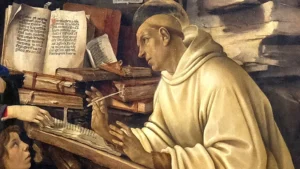
St Bernard of Clairvaux was a 12th century monk who pioneered the reform and expansion of the Cistercian Order. He was an adviser of popes and kings, an eloquent preacher and prolific writer of works of theology and spirituality. Today he is a Doctor of the Church, to whom tradition has attributed the name “Doctor mellifluus”, the “honey-sweet doctor”, on account of his writings about Our Lord Jesus Christ and the Blessed Virgin Mary.
St Bernard was born in 1090 at Fontaines, a castle near Dijon, France, the third son of Tescelin Sorrel, a Burgundian noble, and his wife Aleth, daughter of Bernard, Lord of Montbard.
In his youth he dedicated himself to the study of such liberal arts as grammar, dialectics and rhetoric at the school of the canons of the Church of Saint-Vorles at Châtillon-sur-Seine. He slowly realised that he had a vocation to religious life and at the age of about 22 he entered the Abbey of Cîteaux, the first Cistercian monastery which just a few years earlier had been established by Ss Robert, Alberic and Stephen.
The Cistercians followed a strict interpretation of the Rule of St Benedict, particularly in the practice of the evangelical counsels of poverty, chastity and obedience, but St Bernard took with him no less than 31 young men who were also convinced of their vocations to this form of religious life.
St Stephen Harding, the third Abbot of Cîteaux, recognised the immense talents of St Bernard and after three years he sent him to open found the monastery of Clairvaux in the Diocese of Langres, deep in the Champagne region of north-eastern France.
The community of 12 monks endured a period of “extreme and grinding hardship”, according to Butler’s Lives of the Saints. The monks had a poor diet and initially St Bernard was severe as a father to them, and would be highly critical of any perceived fault. When he saw that this was discouraging the monks, he did penance and changed his approach. The reputation of the community and the holiness of its abbot attracted more vocations and soon there were about 130 monks and the foundations began to multiply, spreading even to Fountains and Rievaulx in the North of England.
Between 1117 and 1130, while at Clairvaux, St Bernard initiated a prolific correspondence with many people, some of whom were of modest social status while others were important. During that time he also developed friendships with such people as William, Abbot of Saint-Thierry, and William of Champeaux, some of the most influential figures in the Church at the time, and his reputation spread throughout Christendom.
From 1130, the talents of the saint were sought by the Holy See and he was often called away from his monastery in the service of the Church. He supported the cause of Pope Innocent II after the disputed papal election of that year, and travelled throughout France, Germany and Italy to promote it. He also founded several women’s monasteries and in his writings he combatted the Cathar heresy and he also condemned widespread instances of anti-Semitism across Europe.
After the Seljuk Turks captured Edessa, a principality of the Latin Kingdom of Jerusalem, on Christmas Day in 1144, Blessed Pope Eugenius III – formerly Peter Bernard Paganelli, a Cistercian monk and one the saint’s former pupils – commissioned St Bernard to preach the Second Crusade to the Holy Land.
St Bernard fell ill in 1153 but was again urged to leave his monastery at Clairvaux, this time by the Archbishop of Trier who feared further bloodshed between the inhabitants of Metz and the followers of the Duke of Lorraine, who had attacked them. He persuaded both sides to lay down their arms and to agree to a peace treaty.
He died on August 20 that same year, at the age of 63. By then, the saint had ruled as abbot for 38 years and had overseen the foundations of 68 monasteries from Clairvaux. St Bernard was canonised in 1174 and in 1830 he was formally declared a Doctor of the Church.
St Bernard is remembered as one of the most influential figures of his generation particularly because of his teachings.
In a General Audience of 21st October 2009, Pope Benedict XVI drew attention to two of the “main aspects of Bernard’s rich doctrine: they concern Jesus Christ and Mary Most Holy, his Mother”.
The Abbot of Clairvaux, the Pope explained, embodied the theologian, the contemplative and the mystic who saw Jesus as “mel in ore, in aure melos, in corde iubilum” – “honey in the mouth, song to the ear, jubilation in the heart”. The saint’s praise of Jesus Christ “flowed like honey”, the Pope said.
“All food of the soul is dry”, St Bernard once professed, “unless it is moistened with this oil; insipid, unless it is seasoned with this salt. What you write has no savour for me unless I have read Jesus in it.”
Pope Benedict noted that “for Bernard, in fact, true knowledge of God consisted in a personal, profound experience of Jesus Christ and of his love. And, dear brothers and sisters, this is true for every Christian: faith is first and foremost a personal, intimate encounter with Jesus, it is having an experience of his closeness, his friendship and his love. It is in this way that we learn to know him ever better, to love him and to follow him more and more”.
The Emeritus Pope also admires St Bernard’s teachings about the Blessed Virgin Mary, that through Mary we are led to Jesus.
Take one of his homilies, for instance, in which St Bernard said: “In danger, in distress, in uncertainty, think of Mary, call upon Mary. She never leaves your lips, she never departs from your heart; and so that you may obtain the help of her prayers, never forget the example of her life. If you follow her, you cannot falter; if you pray to her, you cannot despair; if you think of her, you cannot err. If she sustains you, you will not stumble; if she protects you, you have nothing to fear; if she guides you, you will never flag; if she is favourable to you, you will attain your goal…”
Pope Benedict noted that the example of St Bernard reminds us that “without a profound faith in God, nourished by prayer and contemplation, by an intimate relationship with the Lord, our reflections on the divine mysteries risk becoming an empty intellectual exercise and losing their credibility”.
“Theology refers us back to the ‘knowledge of the saints’, to their intuition of the mysteries of the living God and to their wisdom, a gift of the Holy Spirit, which become a reference point for theological thought,” Benedict said. “Together with Bernard of Clairvaux, we too must recognise that man seeks God better and finds him more easily ‘in prayer than in discussion’. In the end, the truest figure of a theologian and of every evangeliser remains the Apostle John who laid his head on the Teacher’s breast.”
The saintly Abbot of Clairvaux is one such figure.