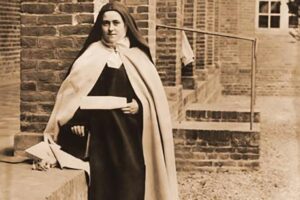
Many people will remember the outpouring of devotion in the autumn of 2009 that accompanied the arrival in this country of the relics of St Thérèse of the Child Jesus and of the Holy Face – also known as St Thérèse of Lisieux. They may remember how tens of thousands of pilgrims queued patiently to venerate the remains of this most popular and best-loved of the saints of our seemingly sceptical and increasingly godless age.
No-one had expected the visit, made at the invitation of Cardinal Cormac Murphy-O’Connor, then Archbishop of Westminster, to be such a spectacular success. The Dean of Westminster Cathedral was said to have been “awestruck” by the numbers of people who turned up to venerate the relics. The pilgrims, he noted, included many lapsed Catholics who had not been to church for years and there were many others who also received graces of healing, conversion and vocation.
Monsignor Keith Barltrop, the Westminster priest who served as national coordinator for the visit, recalled later how he had looked in amazement as “the crowds pressed roses or photographs of loved ones up against the casket”, concluding that such relics “provide a physical focus for devotion” which in turn, he said, revealed “the intense desire for such elemental contact with the world of the holy”.
All of this seems particularly astonishing given that St Thérèse was a simple French Carmelite nun who outwardly differed little from the other sisters in her community.
Indeed, when she died at the age of 24 in 1897 the outside world had no idea who she was. Yet when her short autobiography, L’histoire d’une âme (The Story of a Soul), was published in 1898 she was propelled from anonymity to posthumous fame almost on the scale of a modern day rock star.
The book was continuously reprinted, then published in other languages, and pilgrims soon came to pray at her grave in Lisieux in their thousands and there were accounts of miraculous healing miracles there, including that of a four-year-old blind girl called Reine Touquet. Because of St Thérèse’s extraordinary popularity Pope St Pius X opened her cause in 1914, declaring her to be “the greatest saint of modern times”. His successor, Pope Benedict XV, waived the 50-year waiting period for beatification and she was declared Blessed in 1923 then canonised in 1925, just 28 years after her death.
Within a few decades St Thérèse came to be held in such high esteem by the Church that she was made co-patron saint of France with St Joan of Arc and co-patron of the missions with St Francis Xavier. When in 1927 Joseph Stalin became the undisputed leader of the Soviet Communist Party, Pope Pius XI named St Thérèse – or the “Little Flower”, as she was popularly known – as the patron saint of all works for Russia. In 1997, Pope St John Paul II declared St Thérèse a Doctor of the Church, describing her as an “expert in the science of love”.
Her theology of the “Little Way” can be summarised as the service of charity in each and every action, no matter how little or mundane: whether it is opening a door for someone or bearing a wrong patiently, all deeds are enacted in a spirit of love for God and for neighbour.
Aware of her own “smallness”, St Thérèse wrote of her love for a forgiving God who asked not for great deeds but only for her self-surrender and gratitude. She understood that while few Christians are called to be martyrs or to preach to the multitudes all are called to holiness.
“Love proves itself by deeds so how am I to show my love?” the saint wrote in The Story of a Soul. “The only way I can prove my love is by scattering flowers and these flowers are every little sacrifice, every glance and word, and the doing of the least of these actions for love.”
Such a faith is public as well as private as it has the power to inform every thought, word and deed of every waking hour in the most seemingly ordinary of lives, and to withstand the trials, hardships and the hatred of the world. It is a living faith which is the reverse of the privatised faith dreamt up by modern secularists who are opposed to any faith whatsoever.
St Thérèse was born on 2 January 1873 in the Normandy city of Alençon, the ninth child and last daughter of Louis and Zélie Martin, a married couple and exemplary parents, who were to be canonised by Pope Francis in October 2015.
When she was just four years old her mother died and her father relocated to the town of Lisieux. She was believed she was healed of a nervous disorder through the prayers of the Blessed Virgin Mary and she experienced her First Holy Communion as a deep encounter with Our Lord, and thereafter made Jesus in the Eucharist the very centre of her life.
She discovered the “infinite mercy” of Jesus Christ when at the age of 14 she prayed for the conversion of multiple murderer who was facing execution. “I wanted at all costs to prevent him from going to hell”, St Thérèse wrote in her autobiography, and had the satisfaction of learning that the man had kissed the wounds of Our Lord on a crucifix shortly before his death.
St Thérèse was desperate to enter the religious life and during a pilgrimage to Rome in November 1887 she directly asked Pope Leo XIII, during a general audience, for his permission to enter the Carmel of Lisieux at the age of 15. Her wish came true just a year later and she became a Carmelite “to save souls and to pray for priests”, making her religious profession on the Feast of the Nativity of Mary, September 8th 1890.
She became gravely ill at Easter 1896, a moment, according to Pope Benedict XVI in a general audience of 2011, which “opened the last period of Thérèse’s life with the beginning of her passion in profound union with the Passion of Jesus”.
“It was the passion of her body, with the illness that led to her death through great suffering, but it was especially the passion of the soul, with a very painful trial of faith,” the Pope said. “With Mary beside the Cross of Jesus, Thérèse then lived the most heroic faith, as a light in the darkness that invaded her soul. The Carmelite was aware that she was living this great trial for the salvation of all the atheists of the modern world, whom she called ‘brothers’.
“She then lived fraternal love even more intensely: for the sisters of her community, for her two spiritual missionary brothers, for the priests and for all people, especially the most distant. She truly became a ‘universal sister’! Her lovable, smiling charity was the expression of the profound joy whose secret she reveals: ‘Jesus, my joy is loving you’. In this context of suffering, living the greatest love in the smallest things of daily life, the saint brought to fulfilment her vocation to be love in the heart of the Church.”
St Thérèse died on the evening of September 30th 1897. Her last words, as she looked at a crucifix clenched in her hands, were: “My God, I love you!”.
Pope Benedict noted that “these last words of the saint are the key to her whole doctrine, to her interpretation of the Gospel, the act of love, expressed in her last breath was as it were the continuous breathing of her soul, the beating of her heart. The simple words ‘Jesus I love you’, are at the heart of all her writings”.