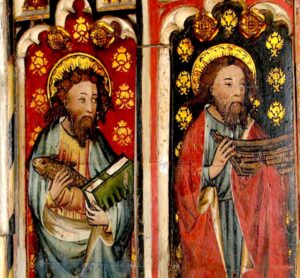
Little is known about the Apostles Ss Simon and Jude. But they are always placed next to each other when they appear in the lists of the 12 called by Our Lord, as recorded in the Gospels of Matthew, Mark and Luke and in the Acts of the Apostles, and there is also a tradition in the Western Church that after preaching in Egypt St Simon joined St Jude in Mesopotamia and that they preached the Gospel in Persia for several years before they died as martyrs in Suanis, probably together. It is for this reason that in the Catholic Church these two Apostles are commemorated together on October 28th.
In the Gospels of St Mark and St Matthew, St Simon is given the surname of the Cananaean while St Luke refers to him as a Zealot. It is a common but perfectly understandable error to assume that St Simon bore that name because he might have come from Cana in Galilee. The truth, however, is that both titles point to the same thing: in a general audience of October 11th, 2006, Pope Benedict XVI said the title “Cananaean” derives from the Hebrew verb qanà’, which means “to be jealous, ardent”, and that Simon was so marked by a passionate attachment to his Jewish identity, the customs of his people, their religion, their vocation as the Chosen People of God, that he was bordering on comparison with the Zelotes, the Jewish nationalist movement.
He was a character who stood in contrast to St Matthew, the grotesquely impure tax collector, and his selection as one of the 12 showed that Jesus called his collaborators from a broad variety of religious and social backgrounds, a prefiguration of the Church, Pope Benedict reminded us, within which, united in Jesus Christ, there is room for all human qualities, charisms, peoples and races.
In the Gospels of St Matthew and St Mark, St Jude is called by the name Thaddeus, whereas Luke calls him “Judas, the son of James” (Butler’s tells us that he is “usually regarded as the brother of St James the Less”).
But it is only in the Gospel of St John where the saint is quoted directly, when he asks Jesus during the Last Supper: “Lord, how is it that you will manifest yourself to us and not to the world?”
The response of Our Lord is to say: “If a man loves me, he will keep my word, and my Father will love him, and we will come to him and make our home with him.”
During his general audience, Pope Benedict said that this response means “that the Risen One must be seen, must be perceived also by the heart, in a way so that God may take up his abode within us. The Lord does not appear as a thing. He desires to enter our lives, and therefore his manifestation is a manifestation that implies and presupposes an open heart. Only in this way do we see the Risen One”.
We hear more of the voice of St Jude Thaddeus in the New Testament letter attributed to him. This is addressed to a broad rather than to a local audience, namely, in the words of the Apostle, “to those who are called, beloved in God the Father and kept for Jesus Christ”.
In the letter, St Jude instructs the faithful “to contest earnestly for the faith” and to be on their guard against the secret entry into the Church of “ungodly men, turning the grace of Our Lord God into riotousness”, who spread corruption with false teaching, and sow division in the Church “in their dreamings”.
In deeply polemical language, St Jude compares such men to fallen angels, and to murderers who “walk in the way of Cain”.
They are “waterless clouds”, he says, “carried along by winds; fruitless trees in late autumn, twice dead, uprooted; wild waves of the sea, casting up the foam of their own shame; wandering stars for whom the nether gloom of darkness has been reserved for ever”.
The Church seldom uses such language today, Pope Benedict reminded us in his general audience, but it is necessary nonetheless to draw out of this letter what is truly important. “In the midst of all the temptations that exist, with all the currents of modern life, we must preserve our faith’s identity,” the Pope said. “Of course, the way of indulgence and dialogue, on which the Second Vatican Council happily set out, should certainly be followed firmly and consistently.
“But this path of dialogue, while so necessary, must not make us forget our duty to rethink and to highlight just as forcefully the main and indispensable aspects of our Christian identity. Moreover, it is essential to keep clearly in mind that our identity requires strength, clarity and courage in light of the contradictions of the world in which we live.”
The letter of St Jude concludes with a call to holiness, a reminder of the mercy of God, the hope of eternal life and finally an exhortation to joy and praise. It is by no means negative and to Benedict it reveals that the author “lived to the full his own faith, to which realities as great as moral integrity and joy, trust and lastly praise belong, since it is all motivated solely by the goodness of our one God and the mercy of our Lord Jesus Christ”.
Beyond the text of the Gospels there is scant evidence of the activities of either St Simon or St Jude. There is a Muslim tradition that St Simon preached the Gospel to the Berbers of North Africa, which may correspond with the tradition that he served in Egypt. The two Apostles are also connected with Lebanon and Syria and, in the case of St Jude, strongly with Armenia, with the Armenian Church honouring him as one of its patron saints along with St Bartholomew. Furthermore, there was also a monastery dedicated to St Thaddeus in what is today northern Iran.
Butler’s Lives of the Saints notes that Western tradition of the mission of Ss Simon and Jude in Mesopotamia might have garnered some support from what purports to be a Latin “passio” of the Apostles, dating from about the sixth century. It speaks of a figure called Abdias, who is said, without proof, to be a disciple of Ss Simon and Jude and a man who was consecrated by them as the first Bishop of Babylon.
Ss Simon and Jude are also mentioned in the Hieronymianum – the martyrology of St Jerome – which gives their site of their deaths as “Suanis, civitate Persarum”. According to tradition, St Jude was clubbed to death there before he was decapitated while St Simon was sawn in half: they are often depicted in art dying this way. Relics of both saints, including the skull of St Jude, were taken to Rome and are now enshrined together below the altar of St Joseph in St Peter’s Basilica.
St Jude Thaddeus is commonly venerated as the patron of desperate, hopeless or lost causes, and of the impossible, particularly following visions of St Bridget of Sweden and St Bernard in which God asked that he be recognised in this way.